Showing posts with label Miscellaneous. Show all posts

Sunday, 1 August 2021

Mullein

Over the past few months, we've been spending a bit of time trying to identify wildflowers. In fact, this has opened our eyes to quite a number of plants that we probably overlooked before and indeed some that we don't recall seeing. 

There's a new cycle route opened recently along the long-retired railway line from Tadcaster to Wetherby. Some of the route, from the Thorp Arch Trading Estate to Wetherby, has been open for a while now (and recently resurfaced which is a much needed respite for my back, bones and bike!) but the link from the Tadcaster to Boston Spa road to Thorp Arch over the River Wharfe is a recent addition to the route. On my first (and previously only) cycle ride up this route, I saw a grey wagtail and there's plenty of other bird life as it is well wooded and plenty of scrub land which is ideal habitat for many species. 

Thorp Arch Trading Estate is on the site of a former wartime Army munitions factory and some of the retail outlets and other businesses are in converted bunkers and wartime buildings. When we first took on our allotment, about eighteen years ago, an old chap who had taken over his allotment from his father in 1946 was using parts of railway carriages from Thorp Arch, dismanted after the war, as sheds. Given that the carriages will have probably have been old, redundant ones used as storage or premises during the war I expect they were probably dating from Victorian times! 


Near the trading estate there's quite a large area of tall, yellow flowers, standing to above five feet (150cm). These we identified as Mullein (Verbascum thapsus) and they were teeming with hoverflies, bees and other insects. However, the Mullein Moth is an early season flying moth and so it was unlikely there would have been caterpillars on these plants 


One of the plants was going to seed, so we have saved some and will try and grow it at home. It is a biennial, like foxgloves, so it will be in two years time that we can hopefully enjoy these lovely plants in our garden or allotment. 


Thursday, 29 July 2021

Context and Accuracy in Climate Change Conversation

I have recently been in conversation online with two individuals about the way in which incidents are described in relation to climate change. 

Of course, very few sensible people now doubt the science of climate change and that it is happening. There are online troll and bot accounts, and indeed individuals linked to some of the known lobby groups and polluting industries that do sow doubt or spread denial messages but sites like www.skepticalscience.com and www.desmog.com are two of my go-to sites for accurate analysis and information on who is often behind such activities. 

There is, perhaps sometimes understandably, a narrative in some environmental circles of "doomism" or "climate alarmism" which can often manifest itself in taking the worst case scenarios in climate predictions and presenting them as a fait accomplit. Michael E. Mann, in his book, "The New Climate War"  looks at how some of these narratives have been sown by some on the denialist side, framing it as being too late to do anything, or a message of fatalism to try and get people to give up taking action against climate change as they claim it is futile. I have had conversations with one of the regular doomist environmental campaigners on Twitter who regularly posts in terms that might just as easily be written as, "THE END" in flashing day-glo letters. I have made the point that if things really are as bad as he is making out, one either would get too depressed to do anything, or would simply think that one might as well do the bucket list while one still can. 

Michael E. Mann talks about urgency and agency. Yes, telling people that we need to do something quickly to tackle climate change but also that one can do something about it, however small or big and also that the sooner we act, the more mitigation can be done. 

This brings me on to the recent conversation about how particular events are described both on and offline. In the UK there is a newspaper, if you can call it that, called the Daily Express that frequently posts headlines taking what might be the extreme end of a storm or snow prediction for some remote corner of Scotland and framing it as being for the whole country. If people believe those predictions they would spend a fair chunk of the year too scared to step outside their front door! 

Also, often in the media and online, one will see headlines such as, "Country x underwater" or "Country y on Fire" when a severe weather or environmental event happens, when actually the event is confined to a particular part of the country. In the bid for the most eye catching headline context can be lost. Is the storm the worst ever? Or just the worst this winter? Has the drought happened before or is it new for the area? Is the wildfire across an entire State or is it localised to a particular area? This isn't downplaying the effects of such events, there can often be loss of life and property and hardship for those involved, but to understand climate change these events need to be put in the context of history and trends and frequency of occurrence, and indeed in the context of the area affected compared to the whole country or region. 

There is of course a fine balance to be struck between the "urgency and agency" as Prof. Mann puts it and ensuring that an accurate portrayal of events is made, one which cannot then be used by the well funded denialists to accuse climate change mitigation advocates in the future of crying wolf or of exaggeration or distortion. Also, we owe it to the wider public to be accurate, to be contextual, to be clear and explain how a particular event may have been affected by the wider climate changes and how the localised effects are creating harm. 

With permission, I have reproduced below a tweet I replied to the other day and will try to analyse this example and rephrase in a more contextual fashion. 

"Germany, Belgium, London, Italy, Pakistan now, floods. USA, Russia, Canada on fire. Any patterns emerging? Anyone? Or maybe it’s just unlucky.  If you want to stop the 50 years of talking and actually be pragmatic and do something, now would be a good time to start."

So, let's start with this. 

"Germany, Belgium, London, Italy, Pakistan now, floods." 

Yes, it is true that the above countries and places are suffering floods, in the case of Germamy and Belgium these are widely recognised as being abnormally severe. However, Germany is a big country, so is Italy and Pakistan, and all of those three have mountainous and other areas that are much less likely, if at all, to flood. Are these floods unprecendented? Are they merely worse than average? Are these a 1 in 25 or 1 in 100 year event, as is calculated by people such as actuaries and insurance agents? 

In London, there's historical record of the Thames flooding on a regular basis into the City, Samuel Pepys mentioned it in his diaries of the 1660s. A severe flood happened in 1928. Is it worse than that? What I do actually know is that the particular events have been caused by surface water flooding from thunderstorms, but here in the UK we get thunderstorms at any time of year, often severe in summer, so heavy intense rain isn't unusual, I've experienced it in York where a number of streets were flooded and buildings hit by lightning. How much has the increase in concreting over of driveways and additional housebuilding and tree cover loss affected the surface water flooding? Is it actually the landscape mitigation of a reasonably frequent event that has changed, rather than climate change making the particular flood worse?

So, from one simple statement there's a whole lot of questions. Can you pin those floods directly to climate change? Would they have happened if the man made climate change wasn't there? Are they made worse by climate change? 

"USA, Russia, Canada on fire." What?! All of them? That's a really big fire and they are really big countries! 

I checked, the wildfires in Canada, dramatic as they seem, are only affecting 0.12% of the country. Still a lot of ground and the smoke is drifting over cities but that is nowhere near the whole country on fire! What is 0.12% of Canada compared to say the size of Wales? (an often used comparision in reporting here in the UK!) Russia is so big that although the Siberian wildfires can be seen from space, most of the country will not be affected in any way by them. 

In 1950, the Chinchaga fire in Canada was the largest single fire in North American recorded history. Was that climate related? Were the 2014 Northwest Territories and 2016 Alberta fires climate change related or made worse from climate change? 

Again, all questions which really don't lend themselves to simplistic reporting. The author of the tweet is right to ask what patterns are emerging, or maybe these are - taken individually - just freak events or indeed are they part of natural cycles of burning and renewal? Is it just that humans have made these events more likely through activities unrelated to putting carbon into the atmosphere - for instance carelessness with littered glass or camping fires or indeed deliberate fire setting, these causes being responsible here in the UK for some wildfires. 

Going on, the author is inaccurate in seeming to imply that people are merely just talking and not doing. I can agree that not enough is being done, there has been inertia, influenced by polluters and denialists, in climate change mitigation, but if you take UK decarbonisation for an example, the switch from coal is nearly complete in power generation and a large amount of renewables capacity, particularly wind, has come on stream with lots more to follow. There's a lot of technical innovation happening, I am invested in a wave power company and also in agricultural robot manufacturer for instance and there's been substantial financial divestment going on as companies manage their risk exposure to climate change and fossil fuels. 

We can say for certain that the incidence and intensity of all substantial climate events, whether drought, floods, hurricane intensity etc is increasing due to climate change. The instability of what did formerly be more predictable weather patterns is increasingly noted and these have effects on land and in nature. There are more "stuck" weather patterns due to variations in the jet stream and heat build up in such as the Arctic is influencing the weather not just in that region but in lower latitudes too. 

However, simplistic headlines do not tell the full story and may even exaggerate or distort the story. Alarmist statements can be used to discredit or dishearten or indeed cause people to give up. However, if events are reported on accurately, the effects are expained and indeed these events are set into the wider historical and geographical contexts then the public can get a better idea of what is going on, how it may affect them and indeed how particular severe events may or may not be related to wider climate trends. 

Wednesday, 28 July 2021

Grazing meadow biodiversity

I took this picture this week, near where I live. I was going for a walk anyway with my family, but having had a rather frustrating conversation with a fundamentalist vegan online I wanted to illustrate the point of how this landscape differs from one which is monoculture crops. This blog is based on my Twitter thread. 

(note - everyone makes their own choices as to their own ethical framework, whether around meat or anything else, but I do find statistics quoted by many vegans online to be misleading, inaccurate and unfortunately there's a failure amongst many to look at the implications of what they see as a utopia without livestock farming)


What you are looking at are grazing meadows for cattle and dairy cows. The grassland is full of clover, some dandelions and buttercups. The field margins have numerous wildflower species and on the day of the walk at least 5 butterfly species and various bees, hoverflies, birds etc (my local patch bird list stands at 90 species since 2010), the hedgerows are good cover for them. 


(Wild chicory, one of many plants along the southern field margin)

If this was arable, nearly all the hedgerows wouldn't be there, the fields are too small for the economies of scale needed, machinery etc. 

The clover would not be there, nor many of the other wildflowers (there might be a few under the "set aside/field margin" schemes but nowhere near as many). The grasslands act as a carbon sink, the grazing is an integral part of the lifecycle and maintenance of the meadow.

Whilst the particular landowner really isn't interested in selling, in many other parts of the countryside these fields would be close enough to a town - and a major road - for housing development to be a real danger to this landscape. 


(Burdock, a substantial plant in one corner of the meadow)

There's other fields near us that are part of rotational farming, where crops are grown sometimes and then livestock (mainly sheep) are put out as part of the cycle. There's fields down the slope from where the photographs are taken that flood every year and grazing is the only farming activity that can be done on them.

Again, the biodiversity present on a flood meadow is far greater than that which would be present on a standard monoculture crop field.


(Ragwort - not in the meadow, as it is of course a hazard to livestock, but along the access road nearby)

The local farmers spend money in our town, some of them supply local businesses. Some local arable crop farming is for the local breweries and I know one local farm that leaves stubble which also helps such as migrating geese and other farmland birds such as grey partridge.

Do you think a remote landowner, supplied by huge corporate agribusinesses, selling into a long supply chain, is better than the above?


Saturday, 3 July 2021

A New Normal

Increasingly, the narrative in the media and spoken from the mouths of political and business representatives is of, "Going back to normal". In the UK, the date has been set for this 'normality' as being July 19th. Negotiations with the virus appear to have failed or maybe never got going in the first place. 

Of course, who wouldn't want to be able to go out to the shops or a restaurant or event without having to prebook, take a mask or take a covid test? It is so tempting, that vision of 'normality', going back to life as it was in BC - Before Covid. 

But that normality was wrecking the planet. 

That normality created a society of haves and have nots

Wealthy and untroubled normality for one person was anxiety or hardship for another. 

Taking off the brakes off societal interactions may cause the thing that keeps virologists up at night - vaccine escape.

There have been many people filling up the pages of newspapers or platforming themselves on social media, gathering with other conspiracy theorists and pseudo-science advocates on marches, even some speaking in Parliament, who feel that the restrictions on our lives that were necessary to reduce the awful death rate from Covid-19 were unwarranted, even to the point of denying the virus itself and its effects. 

The TV presenter Andrew Marr recently suffered from Covid-19, catching it at the super-spreader event also known as the G7 Summit in Cornwall (although some dispute this) Whilst he didn't end up in hospital, he wasn't working for several days and felt pretty ill. There's many other accounts on social media of similarly double-vaccinated people catching Covid-19 and being ill at home. In schools, where children are not vaccinated, and indeed in university towns, the virus is widespread, mainly the Delta Variant originally discovered in India and here because of the lax border controls of the UK Government. The case rate is currently skyrocketing again. More cases means more illness, means more hospitalisation, means an increased chance of a mutation that will escape the vaccines and we'll all be back to square one.

Yes, the vaccines have reduced the effects in many people of Covid-19, keeping many out of hospital, no doubt saving many lives in the process. But they don't stop someone from catching the disease, they don't stop someone from passing it onto someone else that is maybe a person who hasn't yet been vaccinated fully, if at all, maybe someone that for health reasons cannot yet have the vaccine, for instance those who are immuno-compromised. 

Some say that because people aren't dying in the numbers they were at the height of the pandemic, that because hospital admissions aren't at the levels they were, that there's no need for any restrictions on our lives. They've forgotten one thing, one major issue, Long Covid. 

Long Covid is the term used to describe symptoms of Covid-19 lasting more than a few weeks or beyond the main symptoms of the virus. Some people can even suffer from Long Covid despite not having the original symptoms. This can encompass chronic fatigue, lung damage, persistant cough and breathlessness, digestive issues and 'brain fog' - concentration issues amongst other things. No one knows how long they can last, although for many people they do, thankfully, appear to lessen over time and there's been some reports of the vaccines giving an immune system boost which has helped people. But no-one yet knows whether these symptoms will disappear completely or whether there's permanent long term effects on health. 

Up to one in twenty people, including children, have or have had Long Covid. The estimate for April was 1.1 million people in the UK in that month with some kind of long term symptoms from Covid-19, with around 376000 at that time estimated to have had Long Covid symptoms for at least a year. The UK population is about 67 million people. That's a lot of people and a lot of demand on the health system and indeed on Government finances. Many people who were asympomatic with Covid-19 have experienced Long Covid issues. Many will also be those people who have had long term hospitalisation from Covid-19 and the damage wrought by the disease, including someone I know about (friend of a friend) who spent several months in hospital, some of which on a ventilator, and now can only function at home with oxygen supply on hand and has been back to hospital since. 

Sure, go back to your parties, go back to the pub, take your mask off and stop giving people space. Stop caring if you so wish. But there's consequences. Can you live with those? Can the State support millions of new long term incapacity benefit claimants? Can the economy support a possibly permanently reduced workforce? Can families manage their finances if the main breadwinner(s) are out of action for months, with the impact of potential poverty on children's life chances, already damaged by the disruption to education? 

Is 'normal' worth that cost to society and to people's lives? Yes, there are costs to society and livelihoods from the lockdown, and there are indeed balances to be struck between restrictions and the economy, but adopting a carefree attitude at a time when the virus is still spreading, particularly amongst unvaccinated people, is asking for trouble. 

Do we want to do 'normal'? Should we do 'normal'?

I would suggest that the present capitalist, consumer, always on, instant gratification and delivery society is not 'normal'. For most of the history of the human race, our comfy lifestyle hasn't been the norm. Even comparing more developed human civilisations, we are in an exceptional, unprecedented age, where our extraction of resources far exceeds the carrying capacity of the planet. In an age where we have the potential to end life as we know it on Earth.

'Normal' has meant overconsumption. Buying stuff we don't need. Cluttering the planet up with plastic. Decimating biodiversity. Polluting the atmosphere. Warming the planet to climate tipping points with the consequences increasingly on our TV screens. Normal means deaths and preventable disease from the pollution in our cities. Normal means over a million people accessing food banks here in the UK. Normal means a chronic shortage of affordable housing and rent-seeking landlords. Normal means the politics of hate and division. 

Why would anyone go back to that? 


Wednesday, 10 March 2021

Local Food Search websites


As part of my efforts to help people buy more locally and sustainably and help local businesses here in the UK, I am gradually doing a number of blog posts with links to local food suppliers, producers and markets. 

The following are links to a number of general local food search websites. I hope you find them useful!


https://yorkshirefoodguide.co.uk/blog/farm-shops-near-me/


https://deliciouslyorkshire.co.uk/


https://www.livingnorth.com/yorkshire/food-drink/yorkshires-best-food-producers


https://www.sustainweb.org/foodlegacy/local_and_sustainable_food_directories/#english_producer_organisations


https://www.findlocalproduce.co.uk/


https://www.bigbarn.co.uk/local-food-map/


Saturday, 6 February 2021

Cycle ride, lichen and an old way marker

With the forecast for the weekend being for rain and then snow and the weather over the past few days not having been great, I decided to take the chance with a little bit of sunshine yesterday afternoon to go for a short cycle ride into the countryside. 

I've been reading up on lichen recently and it is amazing how many different species there are here in the UK! Looks like there's a lot to learn and some close up photography required


Right now I am not sure what the lichen on the left hand side of this branch is but I think on the right is another example of Xanthoria polycarpa. The tree that it was on I think was a larch looking at the few remaining cones on it. 

This tree was in a small patch on ancient woodland where Catterton Lane crosses the old Roman Road from Tadcaster to York, now marked as part of the Ebor Way footpath. I am looking forward to the bluebells and wild garlic that carpet these woods in Spring! 


On the opposite side of the road, being taken over by brambles and moss is what looks like a boundary stone or maybe even an milepost from the old road. The old route will probably have been in use until the building of the turnpike road which follows the more modern route of the A64. Walking along the old Roman road, I am always very conscious of the way in which the track has been worn into the earth by centuries of pedestrians, horses and carts. Maybe even the army of the Earl of Newcastle in 1642 during the Civil War

Once through Catterton and up the long hill towards Bilbrough, there's a junction and turning left this will lead past Normans Farm to the road between Askham Richard and Healaugh. From this road on a clear day you can see not only back towards Tadcaster and the breweries in the distance, but also looking north west, Armscliffe Crag in the far distance. 


With the sun quite low in the sky by mid-afternoon at this time of year I took the opportunity to experiment with the "Sunset" setting on the camera (though of course you could achieve this by changing the aperture, exposure and iso settings manually). I noticed this dead tree with a lonely crow on it and lining up this with the sun behind the clouds I created what I have entitled "Post-Apocalyptic Crow"!


Friday, 5 February 2021

Snow


This winter has been often very wet with flooding in places but there has also been some frost and snow. Snow isn't to everyone's liking and here in the UK our transportation networks are - despite what I assume is decades of experience - hopeless at dealing with it. However, I am very much in favour of the seasons happening in the correct place and time, two years ago the temperature reached 20 degrees celsius on one day in February which really isn't normal! The study of phenology has a long history here in the UK with records going back centuries in some cases, observations such as the first appearance of flowers, of blossom, of the first swallow among many other things. Spring has been getting earlier due to climate change and in general the weather has been getting more chaotic, and milder winters are often the norm nowadays.

So, to me, having a "proper" winter is reassuring. Knowing that the frost breaks up the soil into a tilth, that it sweetens the parsnips, that the many plants and bulbs that need the cold as part of their life cycle get what they need. Too harsh a winter can of course reduce populations of birds and other species but we humans can help with that by supplementary feeding and land management such that food is available for them when they need it. 


Tuesday, 2 February 2021

Not yet Spring!

 I've not been writing much on the main part of the blog just recently as I have been concentrating on the list of Markets in Yorkshire and Lancashire which you can find here. However, despite the cold, snow, frost and rain, we've managed to get to the allotment a few times to dig over and tidy, although the ground has been either too frozen or too mushy to get much done on many occasions. 

Likewise, getting out for exercise in this latest lockdown has often been difficult due to the weather and the River Wharfe and Ouse and various feeder streams have been flooding into field and over roads. The edge of a bridge on the road near Bolton Percy (from Tadcaster) looks like it had collapsed into the water when I cycled down there last Friday. 


Further down the same stream, in Bolton Percy itself, you can see above how far the water has been , with the houses to the left of the photo only just above the water line. The road would normally take you round the back of the village or to some farms and cottages. After I took this photo I was watching Long-tailed Tits (Aegithalos caudatus) in the trees and then had the surprise of a female Blackcap (Sylvia atricapilla) on a nearby bird feeder, some of the latter now overwinter in England although most do still migrate to Africa. 

Coming back, I paused at a gate to examine the lichens on it. This is an area of nature I want to learn more about and although the cost of the field guides is quite high, there are some internet resources too. 


Whilst I wouldn't be that confident in my identification, the light coloured leafy one in the foreground may be Physcia tenella and the yellow one behind it may be Xanthoria polycarpa. These are common lichens throughout England. I am not sure what the leafy moss/liverwort is nor the other lichens as yet. 

Behind this gate is the tree I like returning to, which I mentioned in this blog last year near the start of the first lockdown. Bare just now, like other deciduous trees, it is domant awaiting the arrival of longer days and warmer weather. 


A lot of fields are flooded around us right now, and with the cold weather these often turn to ice. However, on the way back from Bolton Percy these Mallard (Anas platyrhynchos) had found a patch of unfrozen water on a field and were enjoying the experience! The drakes seem to have very glossy plumage at the moment, no doubt in preparation for the breeding season to come. 


Finally, a hint of Spring (though no one has told the weather that, as there's snow on the ground today!)


Wednesday, 9 December 2020

The Courtyard Dairy and Camphill Trust

It has been quite a while since I have driven up through the Yorkshire Dales and even when I did do the journey for work I rarely had time to stop and explore. So, whilst going to collect my youngest from university, I dropped in for a break from driving at The Courtyard Dairy just off the A65 beyond Settle

At the moment, there are of course safeguards and restrictions to protect transmission of Covid-19, and so the coffee hut in the foreground of the picture below was self service, but still a nice cup after quite a long drive!


However, the main reason to call here was to get some cheese and they have an amazing selection of small producer cheeses from all over the UK. 

A perspex screen seperates the customer from the staff in the entrance, which is just around the corner from the end of the path by the far building. However, there is a slot in the barrier, with a cheese board upon which samples of cheese are put by the staff for customers to try!

I opted for two cheeses, Young Buck - a blue cheese made in Northern Ireland and Dale End, made at Camphill, Botton, North Yorkshire, a community of learning disabled people. 

When buying the cheese, I wasn't aware of this community, but having supported learning disabled clients in care work it was very pleasing and interesting to me to find out about the work of the Camphill Trust  and that I have bought a product which supports this community. 

As I have said many times, it is so important to support local businesses and food producers and this will be especially important over coming months and years given Brexit and the UK Government's proposals for the farming sector. 

https://www.thecourtyarddairy.co.uk/

https://www.camphillvillagetrust.org.uk/how-we-work/


Thursday, 26 November 2020

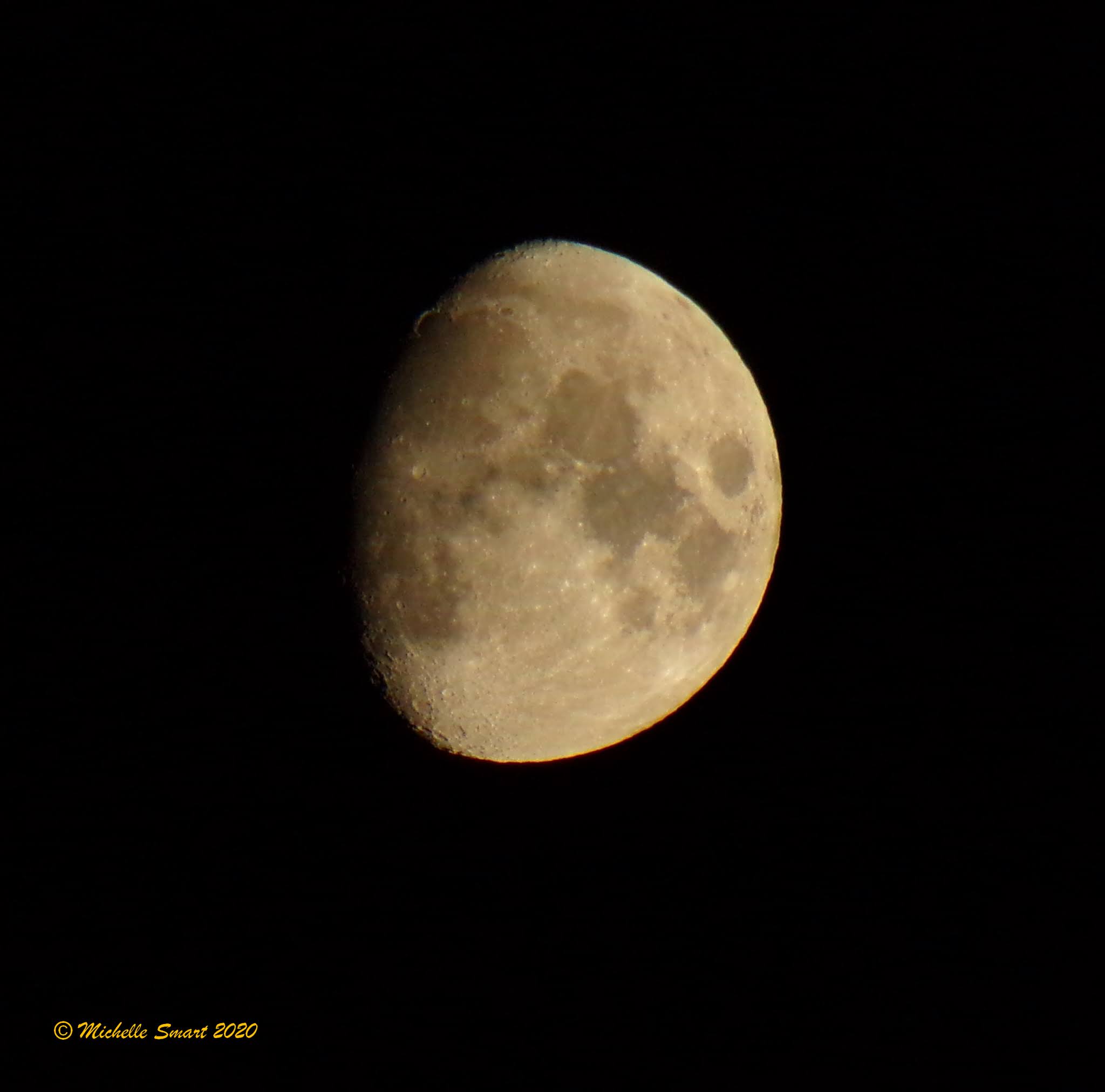
25th November 2020 - Lockdown 2 - Day 21 - Moon and Mars

 Just a quick one for this evening. I am busy learning how to use my new Omegon LX3 Minitrack for astronomy photography, amd indeed the camera settings necessary for this. 

Last night was clear and so I got a nice picture of the moon for starters. 


The next one is of Mars, in the constellation of Pisces. I'll need to work on this another night, to try and produce an image of Mars without the "starburst"effect, this was on a 30 second exposure with the clockwork motor running on the tracker, however, the image is sharp and the colours of the stars in the shot are noticable. 


I need to look at layering multiple photographs as well and experiment with different aperture and ISO settings and timings. However, tonight was all about just learning how to use the tracker so it was a good result!


Tuesday, 24 November 2020

24th November 2020 - Lockdown 2 - Day 20 - Book Review and home grown

Recently I have finished reading "A Green and Pleasant Land" by Ursula Buchan, borrowed from the library just before the second lockdown. 

There's a collective folk memory based on the "Dig for Victory" poster, an idealistic image of everyone on the home front growing their own crops and being self-sufficent. This book sets out to explain what actually happened and the different approaches to ensuring that the nation had enough to eat during the wartime years. 

Much has been made of how parks and public spaces were turned into allotments and how it was encouraged for people to turn over large amounts of their garden to fruit and vegetables. However, a survey done in 1944 showed that under half of households grew some of their own fruit and vegetables either at home or on an allotment. There would be many reasons for this, not least of which either space at home or lack of time or manpower to undertake this, though many observed during the war that many who could have grown their own did not do so. 

The book also looks at cultivation on farms, the efforts of the Women's Land Army, how gardening was covered in the media, and how changing farming practices, for instance with chemicals, changed the landscape and habitats. The efforts of the WI, particularly in preserving fruit and distributing food, are also documented. 

My view of grow-your-own is this - if you have room to grow something for yourself, you should. Whilst even our present Covid-19 crisis does not compare to the hardships and issues encountered in the Second World War, those who can take a little of the pressure off the food supply chain should do so, and indeed reduce their food miles and reap the benefit of ultimate freshness that the market can't provide. That being said, I acknowledge that not everyone can do this, though I often mention my grandparents growing tomatoes and cucumbers in the window of a tenth floor council flat in inner city Leeds! 

It is not about total self sufficiency either, most of us are not lucky enough to have the two or three acres that would make this even remotely achieveable. However, with a little planning you can have elements of many of your meals that are entirely your own growing efforts. 

Today, for instance, we had home grown preserved pears on my porridge and home made damson jam (damsons from the allotment) on my oatcakes at breakfast. At lunch, a home grown apple with more damson jam on one of the sandwiches. At tea, with the pie was home grown potato, as well as home grown carrots and parsnip, and a little spinach beet, broccoli and some very small sprouts (the latter three are pretty much at the end of the crop now!). These are all from the allotment and served two people.  


Even if you don't have that much room, pears and apples can be container grown minarette trees and carrots can be grown in an old dustbin or tyre stack. Spinach beet is a cut and come again crop, so should be able to be grown in a large container like salad leaves. 

Saturday, 21 November 2020

21st November 2020 - Lockdown 2 - Day 17 - Remembering Hverir, Iceland

 Back in 2010 on our second trip to Iceland we drove from Akureyri to the Mývatn area to see the various volcanic features and to explore the lake area. One of the places we wanted to visit was the Hverir Mud Pots, an area of volcanic activity to the east of the lake, just over the next hilly area from the lake. 


This was an incredibly alien landscape, in fact it was more like Mars than anything here on Earth!

We didn't stop long as the stench from the sulphur was quite overpowering but seeing the strange colours and bubbling pools was something special.


Monday, 16 November 2020

16th November 2020 - Lockdown 2 - Day 12 - "Unexpected" Events

For many people living here in the UK, untoward natural disasters and other emergencies have been something that happens to other people. Most people don't have to cope with more than a few inches of snow for a few days or maybe a fence blown down in a gale. I've seen on the television or heard on the radio how some people cannot cope with a couple of inches of snow on the ground and there is often a  risk averse culture that closes many schools at the first hint of snow. The way in which some radio and newspapers report weather events of the prospect of such events is sensationalised and does seem to make out that stepping outside is far riskier than it actually is. Don't get me wrong, for some sections of society, snow and ice can cause mobility issues, but when I think back to childhood and - despite having some really snowy winter weather at times - my primary school never closed for a snow day despite being up a hill and my secondary school only once, and that was due to the boiler packing up. (I didn't hear the announcement on the radio that morning and actually had walked to school in deep snow to discover it was shut!)

In some parts of the country having to cope with the effects of heavy snow are regular event in winter and you find in those countries that get a lot more snow than we do here in the UK, they are better equipped and organised to deal with it - in fact the morning after we had arrived in Moscow in late March 2014, with snow falling when we landed the previous evening and all night, the roads and pavements had been cleared and all was running normally with transport. We get snow every year in the UK, it should not come as a surprise and I do think that we should be able to cope as a country more easily than we do. 


Flooding is an increasing risk for many people as extreme weather events with large amounts of rainfall happen more frequently. There is a tendency more often nowadays for the "jet stream", that carries Atlantic weather systems across to the UK from the west, to get stuck in a repeating pattern, so rather than an alternating pattern of rain then settled weather, the weather systems keep rolling in off the Atlantic. 

For the south of Englang in particular, extreme hot weather is happening more frequently in summer, temperatures that have been unheard of until the 21st Century have been recorded - it might not sound like much to someone reading this blog in the Persian Gulf or Arizona but 100 degrees Farenheit (37-38 degrees Celsius) is very hard to deal with here in the UK as our buildings are designed to keep heat in rather than keep the inside cool, and most homes and many offices do not have air conditioning. 

Aside from weather, unexpected domestic events can happen. During the seventeen years I ran an IT department, I had to deal with two lightning strikes on the building, a leak in the airconditioning system on the servers, a crane snapping a telephone wire to the building, road workmen drilling through another phone cable and various power failures. I spent a lot of time on emergency planning, and we as a country, both nationally and in our own domestic settings, need to get better at being prepared and resilient against unexpected events. 

However, the Covid-19 pandemic is the first event for some time that has affected the whole country and despite having had reports and committees on preparations for such an event, this Government seems to have been lacking in planning for this, and has not been very successful at all in managing the situation. This has had, as many of you will be aware, a huge cost in lives and in livelihoods. 

Panic buying at the start of the pandemic created artificial shortages of many goods, and it took quite a while for the supply chain to resume a more normal status though some changing demand, particularly in such as flour where demand in catering stopped and demand at home rose, was less expected. Home delivery services were overwhelmed and huge queues built up outside supermarkets as numbers inside were limited. 


As we ourselves had been storing additional food in case of a no deal Brexit for some time, we were protected to some extent from shortages, although such as gluten free bread and cereal (for one of my daughters) was an issue for a little while. We are much dependant on supermarkets than many other people, but even so at one point, the local butchers had very little meat left one afternoon when I went round to get some chicken. 


This brings me to the looming inevitability of the end of the Brexit Transition Period. Many people assume that if there is some kind of deal at the last minute, all will be well, but as the UK is leaving both the Customs Union and the Single Market and a whole host of regulatory frameworks, there will still be a huge amount of disruption to trade. The systems for processing many thousands, if not millions of new customs declarations are not ready, not enough customs agents have been trained to deal with these, infrastructure at ports is not ready and far fewer permits have been given to UK lorry companies than are needed for the volume of trade with the EU. 

Thus, there will be disruption. At the very start of next year, the effect may be slight, due to the New Year holiday and the fact that importers will have been able to schedule deliveries a little bit ahead for just before the end of year. But storage is not infinite and many products, such as some fruit and vegetables, rely on short lead and transit times to bring them to market whilst still fresh. As we move towards February and March, local supplies of such as apples and salad crops will be diminishing, and reliance on imports grows every year at that time, in fact by early Spring this was historically known as the "hungry gap". 

As supplies run short, prices go up. This will hit many consumers hard, many already stretched by unemployment or other hardship caused by the pandemic. Those of us who have perhaps a bit of money to spare should step up and help those without through such as food banks. Community work will be important to ensure no one is left vulnerable.

Ideology does not fill stomachs. Three word slogans do not fill supermarket shelves. Not just here in the UK, but in many countries it has been the case time and time again that sections of the population have been persuaded to support leaders who then go onto enact policies that cause harm, whether it is to the environment as in Brazil presently, or persecution of minorities, failure to safeguard the vulnerable or keeping people poor through systemic inequalities. Somehow or other we need to ensure that facts rather than distortions, complicated but right arguments rather than simple but wrong ones win through and also that we build a society that looks after each other and in which everyone is supported and fed. 

In my Small Steps blogs below, among other things I look at resiliency and preparedness

http://www.cashandcarrots.com/2020/06/lockdown-day-77-small-steps-part-1.html

http://www.cashandcarrots.com/2020/06/lockdown-day-78-small-steps-part-2.html

http://www.cashandcarrots.com/2020/06/lockdown-day-79-small-steps-part-3.html

http://www.cashandcarrots.com/2020/06/lockdown-day-80-small-steps-part-4.html

Sunday, 15 November 2020

15th November - Lockdown 2 - Day 11 - "Corporate Diet"

Before I start, and before I get piled on, I respect anyone's choice to choose any particular diet based on their own ethical frameworks. This isn't what this blog is about and each to their own. 

I have been very concerned of late by supermarkets pushing what are often ultraprocessed foodstuffs marketed and supported by big corporations under the guise of "plant-based" or "vegan". I first started looking into this when I saw a big stack of black plastic and plastic wrapped ready meals in a supermarket under a big sign advertising "Veganuary" last year. It struck me as very odd that what is purported to be a diet that is marketed as being "better for the environment" should be used as a pretext to push what looked to be very processed foodstuffs containing a multitude of ingredients, not all of which I recognised, in what is often a difficult to recycle plastic format. 

One of the first things I looked into was the term "ultra-processed". I was already familiar with the term "processed food", but this is a term that denotes a very high level of manufacturing involvement and processing in the ingredients of products, often pre-prepared meals and other items. 

Joanna Blythman - a regular columnist in various newspapers - sums up "ultra-processed" here very well 

I also came across the terms "pea protein" and "pea isolate". Now, on the face of it, peas, what can be wrong with peas? In their normal form, cooked or raw, they are a tasty and nutritious vegetable, cheap and available fresh or frozen. But then I read about the manufacturing process for the extraction of pea protein and this is a very good example of the ultraprocessing method. Soya protein is also extracted in a similar process, using hexane - derived from oil, although it is said that the extraction of pea protein does not use this. 

As Joanna Blythman says, the more processing takes place, the more a multinational company can "add value", in other words, charge more and claim more market share. More market share for multinationals is often at the expense of local companies and farmers. 

Burrowing deeper into this, I started to read about the EAT Forum, founded by the Stordalen Foundation, which was founded by a Norwegian billionaire and his wife, having made their money in hotels, shopping centres and owning an airline. They also seem to spend a lot of time travelling by their own private jet around the world  Which to me doesn't seem like they are walking the walk when it comes to reducing their emissions. The EAT Forum came to a lot of public attention when they proposed the EAT-Lancet Diet, primarily plant based which has been the subject of a lot of controversy and indeed may not make the claims it does  and throws up some really odd suggestions

This lead me on to FReSH which was founded by the EAT Foundation and World Business Council for Sustainable Development with the involvement of the companies shown in the graphic below


The involvement of big food corporations such as Cargill and Pepsico as well as big agrochemical companies such as Bayer and Syngenta as well as a host of other huge multinational corporations in proposing what seems to be a global diet is really quite concerning. These corporations are able to lobby Governments at ministerial level and often have slowed down or even caused abandonment of many proposed beneficial environmental changes, or stopped harmful chemicals from being banned. 

Of course, any agrochemical company would be very interested in a proposal that results in more crops being grown with, of course, more of their product being used upon them. 

As I went into this further, I noted the involvement of the WEF - World Economic Forum . You may have heard of it in connection with a gathering of the rich and powerful and Government representatives at Davos, Switzerland, every year, which in years gone by has been the focus of many anti-globalisation protests. Attendees are whisked there in what is one of the largest gatherings of private jets in Europe......

Frédéric Leroy has been doing some great digging on the links between all these organisations and shows how plans under heading of #GreatReset and #BuildBackBetter (some of which seem very benefical on the surface) for post Covid-19 policy also include a diet part. Robert Kennedy Jr also goes into detail about how the WEF is proposing quite far reaching changes on the back of Covid-19 rebuilding. The mission statement of "Impossible Foods" - with close links in the this area and recently in the press for the "Impossible Burger" has a mission statement of "Eliminating the need for animals in the food production system by 2035". 

Now, before anyone thinks I am going down the conspiracy theory rabbit hole, these are verifiable references and published aims and policies that I have referred to above. My great concern is this, the WEF, FReSH, EAT etc are taking what are quite genuine concerns of many people about the impact of their diet upon this planet, and using this to nudge consumers in the direction of products that are marketed with huge budgets, made by the same corporations that have done so much to destroy biodiversity and indeed have often exploited not just natural resources but people in low income countries as well. 

With the involvement of huge agrochemical companies, that are well known for lobbying governments and the EU to slow down or stop harmful chemicals being banned, a switch of land to more crop growing will come with significant impact on insects and pollinators, as well as the known impacts of run off into streams, and sometimes human harm too from chemical spraying. The "chemical cocktail" effect of multiple sprayings is under-researched and such as Dave Goulson here in the UK has been looking into this and his books about bees give great insight into these effects. 

Finally, in terms of here in the UK, what we have a lot of is pasture, in fact much of our land is not suitable for growing crops but is very suitable for livestock. Livestock farmers here have already had to cope with suppressed prices for their animals at market, a massive drop in the price of wool, and shortly the potential loss of EU as a major export market with the cliff edge of the end of the Brexit Transition period. Grassland is a carbon sink, it sequesters carbon, and if you go back to the time of the Second World War and afterwards, up to 97% of our wildflower meadows - formerly grazed - have been lost to the plough (albeit in the 1940s from some necessity). So, ploughing up grassland - even if that area of the UK is suitable for crops - will release that stored carbon into the atmosphere. Also, if we have fewer animals here in the UK and then rely on more imports of plant based foods, again that will push up emissions, and indeed outsource environmental harm as many other countries do not have the same environmental standards as we do here in the UK. Also, animals produce manure, which in a regenerative and rotational farming system goes into fertilising the soil without the need for chemicals. 

Again, if one chooses not to eat meat for ethical reasons that is up to one's own conscience, but my point is that without careful selection of where the replacement foodstuffs come from and how they are made, it is not necessarily going to be a good choice for the environment or indeed some of the people who produce this food. It may well hand more profir and power to corporations that have already caused a lot of harm to the environment. Do we really want big, almost unaccountable corporations and forums telling us what we are allowed to eat? Your local sheep farmer does not have anywhere near the same voice and influence as such as Bayer or Monsanto. As we have seen with the latest UK Government Trade Bill, even massive campaigning by farmer's representatives and public petitions for food standards, have only had limited effect on the legislation, and it will be to the detriment of those who get up in all weathers and at all hours to produce our food. 

I for one will be continuing to buy my meat from a local butchers, with the animals from whence it came being raised in Yorkshire, much of which at a farm just three miles from my house. I grow a lot of my own vegetables and fruit, but those I buy in I try to get mostly from local greengrocers and farm shops or markets. Surely a diet free from as much factory processing as possible is better for your health and for the environment. Supporting local producers as far as possible keeps money in the local economy. Supporting fair trade goods for those items that have to come a long distance - for instance fair trade bananas - means that the producer gets more of the income from your purchase rather than a corporation beholden only to their shareholders. Of course, one can only do so much, and there are the limits of accessibility, money and time to consider. However, in order to produce a fairer world for all, we should ensure that those who produce our food are the ones benefitting from our purchases as far as possible rather than unaccountable corporations and opaque forums for billionaires to work out how they can get richer. 

Saturday, 14 November 2020

14th November 2020 - Lockdown 2 - Day 10 - Local Food

 One of perhaps the few silver linings of the first lockdown was that when panic buying swept shelves in supermarkets clean, many people looked to local shops and suppliers to provide groceries. It does seem that to some extent, this buying pattern has continued, albeit perhaps not to the same extent. 

In a few short weeks, the UK faces a cliff edge of the final Brexit transition end point. The Road Haulage Association and many other people in the sectors of logistics and ports have warned of a crisis as the systems to handle customs declarations and inspections for goods coming in and out of the UK are nowhere near ready. This will also affect many farming, and (rather ironically) fishing businesses who export to the EU. There are major issues around certification, particularly for seeds and organic produce as the UK will leave the EU certification systems at the end of the year and there is a delay of several months for application for these from a non-EU country. 

I've mentioned before (in my Small Steps series and here) about how one can be more prepared for food supply issues. However, what one can also do is to support local producers and businesses, and this is especially important at the moment when there is such a large impact on trade from the Covid-19 pandemic and necessary lockdowns. 

So, I am starting to put together here a list of local markets, businesses and suppliers, initially in Yorkshire, that can be supported with trade. Buying locally wherever possible and from individual small businesses keeps money within the local economy, often reduces food miles, can use much less plastic and can contain fewer embodied carbon emissions. Local food in season is often fresher than items from a supermarket shelf that may - even if produced in the UK - have travelled hundreds of miles to reach the store. (However, at certain times of the year - for instance in Spring when our apples are not in season and winter stores have run out - it can make sense to buy from parts of the world where they are in season if the produce has come in bulk on ships) 

I've mentioned a few times that the two butchers I use, one of which is just around the corner from our house, source much of their meat from local farms, our nearest one sources beef, pork and lamb from a farm about three miles away. We use a farm shop which sources local vegetables when in season. Even if the produce isn't that local, the shop selling it is local, and it still supports local people who then spend their earnings in the local community and can support local businesses in the supply chain. 


Friday, 13 November 2020

13th November 2020 - Lockdown 2 - Day 9 - allotment and lockdown

 After some early morning rain, today was a very sunny and dry day. Managed to get out for a quick cycle ride (about seven miles) around lunchtime, though bird life was very sparse along what is usually quite a biodiverse country lane. After lunch, a trip to the allotment to pick cabbages to make another batch of kimchi using a recipe which you can read about here. Also picked another parsnip for tea, deep fried as parsnip chips with some home grown potato chips too. There's still apples ready, and some of the last borlotti beans that have been drying on the plants, they have now come inside for further drying on newspaper upstairs. 

The winter onions and garlic have established well in the allotment, they are rooted enough not to be pulled up by inquisitive blackbirds!


Over the past couple of weeks, there's been several people I know that have gone down with Covid-19, makes it more personal when it is people one knows. They all are or have recovered though as far as I know which is a relief though I have heard about two people whom friends/relatives know that have died of it. Whether this present lockdown will work is to be determined, it does really depend on behaviour of individuals both during and more importantly afterwards in the run up to Christmas. 
Whilst I can always find things to do and we are secure in income even with my furlough payments, others aren't as lucky either financially or indeed in having the easy access to countryside we have or space to grow one's own food. 
Whether there's going to be long term positive shifts in behaviour as a result of this pandemic, for instance the continuation of a lot of home working or indeed many continuing to grow food for themselves, is to be determined. Community spirit, people helping each other out, can be more durable. One thing that does really concern me is the shift away from public transport as, quite legitimately, people reduce their risks by using their own cars if possible for journeys, rather than a potentially busy bus or train. We need people to one day get back to using buses and trains for business and leisure, rather than their cars. Hopefully the infrastructure that is being put in by councils, with central Government funding, for improving cycling and walking will help matters and mode shift many people's journeys. We have been over a newly opened cycle path using the route of an old railway line, with a recently rebuilt bridge over the River Wharfe at Newton Kyme. This was very pleasant and away from busy roads, and when we did the journey about a month ago we saw a Grey Wagtail on the path as well as a lot of other bird species in trees alongside. 


Wednesday, 1 July 2020

Lockdown Day 100 - The end of the beginning

This is the final blog of my lockdown series, little did I know that when I started these on the 24th of March that I would be still on lockdown and furlough at the start of July. The dreadful COVID-19 virus has claimed many hundreds of thousands of lives worldwide and the UK has had around 65000 of these. This high death toll could have been avoided here in the UK if lockdown had happened earlier and been stricter and if many elderly and vulnerable patients had not been discharged without being tested from hospitals to care homes. No doubt there will one day be Inquiries, Reports and maybe one day those in charge will be held to account, but as happened with the Hillsborough disaster, it may be that the true story is covered up for years.

I hope that my readers are still safe and well, and continue to be so, and I extend my sympathy and condolences to anyone reading this who has lost a loved one or friend to this awful virus.

We have been lucky, no one I know personally, no one in my family to my knowledge has been affected by the virus (although I have heard about others on the grapevine) but that does not mean we will stop being vigilant and taking what precautions we can for months to come. There is also the looming No Deal Brexit here in the UK which has the potential for serious disruption to supply chains just as maybe the UK economy is recovering and I will be continuing with actions and preparations as outlined in my small steps and prepping blogs, as well as of course the allotment and preserving the food we grow.

Whilst I spend a lot of time out in the countryside, this lockdown has given me a chance to identify more plants and wildlife, to spend "slow time" out in nature, to enjoy the peace and quiet with no traffic noise and just birdsong for company. We are lucky here compared to many people with countryside all around a few minutes walk or cycle from home, but even in the cities and former industrial sites there are many places where nature finds a home and my Edgelands blogs are an insight into that world in the margins of the urban sprawl.

It has also been a chance for me to delve into my photo library from many trips and holidays and my "Remembering" blogs have been a chance to relive many special wildlife experiences we have had in countries around Europe.


Whilst in many parts of the world, and indeed in the UK, there are many places where nature is protected, there are serious threats to this biodiversity all over the planet, whether through human destruction, pesticides and other chemicals and pollution, climate change, microplastics, road building and many other threats. It is so important that the recovery from COVID-19 is a "green" recovery, an attempt to "build back better" and a chance to change the whole economic model from one of excessive consumption and a throw away society to one where our needs are met through environmentally sustainable methods of production. There are unfortunately, many people, often excessively rich or with vested interests (such as fossil fuel) who seek to undermine this transformation for their own gain, who seek to influence governments and indeed the fabric of democracy and accountability itself. My "Road to Recovery" blogs were based on a letter I wrote in response to a request for feedback from a civil servant in the Cabinet Office in the UK Government. These are an attempt to show what needs to be done to achieve that more sustainable, democratically accountable and fairer society that we need if we have any hope of keeping our small blue and green world a habitable place for all the people and wildlife on it. (There is of course a particular focus on the UK in the blogs)

The allotment has had a lot of love these past few months and the fruits of this are being realised, quite literally, with now at least ten punnets of blackcurrants picked, several punnets of raspberries and strawberries, with blackberries and blueberries to come, along with apples, pears and damsons for later in the year. We've tried to create a home for nature too, leaving some nettles and wild poppies to grow, keeping the marigolds and nasturtiums and comfrey going and planting more lavender. At home we are trying to expand the number of flowers good for pollinators even though we have quite a small space to do this in, and given that today yet another front garden down the street was concreted over, more important than ever that we create that haven in our locality.

2020 will be regarded as one of those defining years in history where everyone can remember what they were doing when lockdown started and everyone will, unfortunately, end up knowing someone who has suffered or died from COVID-19, and everyone will have a lockdown tale to tell to a future generation when they are much older. I hope that the beneficial shifts we have seen in behaviour, whether such as more cycling and walking, using more local businesses and food, more home working, online meetings and collaboration to name but a few, will continue post lockdown. The desire for equality and freedom for discrimination for BAME people, and the toppling of statues has also been a defining moment in history and this fight will need to keep being fought given that there are many in our society both here and in other countries that are racist and intolerant, and this extends into positions of power too.

We need to move quickly in de-carbonising our energy supply and supply chains. We need to urgently reduce the amount of plastic being used and move to a more circular economy without excessive consumption. Deforestation and other environmental harms need to come to an end and habitats restored, there are already climate and environmental tipping points being approached or reached in the Amazon, Arctic and Siberia and serious harm being done in our oceans.


Our own contribution to improving the environment and making more sustainable choices may seem miniscule in comparison with the challenges we face. But consumer pressure works - the plastic bag tax has substantially changed behaviour, campaigns on fair trade, palm oil and many other things have changed the operations of big companies. Many governments have responded to the challenges of de-carbonisation and campaigns such as the opposition to fracking here in the UK have effectively brought a halt to this destructive form of drilling.

Everyone has local representatives, whether in local or national government. I've written to my MP on several occasions and had letters back from two different ministers via the MP. There's so many different charities and campaign groups out there for different human and environmental issues. For the next few months at least it will be even more important to support the vulnerable in our society and those that care for the environment in which we live as many charities have a very steep loss of income at present and the needs are still out there and increasing. Over the next few months pressure needs to be brought to bear so that the recovery from coronavirus, particularly any infrastructure spending, is sustainable and is in keeping with meeting our climate change mitigation commitments.


Auditing our own spending is worthwhile, whilst it is good to have a treat or two for time to time, do we really need the latest phone or computer, or spend a hundred pounds or more on an item of designer clothing made in a cramped factory with poor working conditions in the Far East? A lot of my clothes have come from charity shops in perfectly good condition, some even still new, we've bought crockery, books, furniture and many other things from charity and secondhand shops, supporting good causes and local businesses in the process as well as re-using goods that may have otherwise gone to landfill. Over time we've donated many things we no longer have use for to feed back into the circular economy and allow more money to be raised for charities.
There's many local craftspeople and local businesses that can supply new sustainable goods, again keeping money in local economies and the "fair trade" movement extends this out to many parts of the world to support particularly third world producers in a decent living.
There's many "green" energy tariffs out there and if you can afford it, the switch to electric vehicles or bikes, and perhaps your own household renewable energy generation is a possibility.

I hope you have enjoyed my blogs as much as I have enjoyed putting them together. I've learnt quite a bit about nature these past few months and had some lovely wildlife moments, as well as reliving some special occasions from the past. Everyone can do something for our environment, everyone can grow something for themselves, everyone can buy the things they need more sustainably, everyone has a voice in the debate and collectively we can change our world for the better.

Best wishes, stay safe and well and good luck!
Michelle
1st July 2020

Monday, 29 June 2020

Lockdown Day 98 - Rhubarb and Pumpkin Compote

Another rainy and grey day today, so I have been inside catching up on a few jobs. As we pick the berries we need all the freezer space we can get so I did a little digging and found a bag of rhubarb and some pumpkin from last year! It seems to have kept fine, albeit a little longer than expected so I have boiled it up with some sugar and some ground ginger to make a compote which I can use on porridge over the next couple of months.

I've planted some more pumpkins and expect to be able to do quite a bit of chutney later in the year, either ginger or spiced up with cumin and chilli powder. Ideal for putting on cheese or cooked meat sandwiches or as an accompaniment to spicy Indian dishes.

I also do courgette and onion chutney if the courgettes get too overwhelming!


I have two "go-to" books when it comes to preserving:


The Complete Book of Preserves and Pickles by Catherine Atkinson and Maggie Mayhew published by Anness Publishing Limited

and


 The Preserving Book by Lynda Brown published by Dorling Kindersley in conjunction with the Soil Association