Showing posts with label Vegetables. Show all posts

Monday, 8 May 2023

Allotment Update

It has been some time since the last blog, I really ought to keep up to it! One of the things I have been doing quite a bit of recently is recording sightings of various species on iRecord which is a fantastic resource, like iNaturalist and BirdForum for recording sightings. Another app I have been using is PictureThis which, although not perfect, does get most things right or at least lead one to the right species or family. 

Anyway, on to the allotment. This Spring has been quite cool. This has been good for stored fruit and vegetables from last year such as apples and onions but not good for getting new crops going! 


The blossom on the Conference and Comice pear trees.
The blueberries have had plenty of blossom too!

I do wonder whether the apple trees will produce quite as many apples this year, but they do have plenty of blossom and look really lovely. 
This is a mixture of overwintered onions and garlic and this year's onion sets. Leeks are starting to pop up in the patch at the rear. Also in this area, out of shot, are rows of parsnip seeds and spring onions. 

Although it has been cool, there's has hardly been any late frosts, just a small number of nights where I have had to cover over the potatoes and fruit trees to protect them from damage. 

Sunday, 1 January 2023

Winter Protection in the Allotment

 Many of the plants in the allotment are winter hardy - the fruit trees and bushes shut down for winter and vegetables like parsnips and leeks will be fine in cold weather. However, a few of our plants do need a little bit of extra protection at this time of year. 

This is our Mayer Lemon tree. It used to live in our house but was always getting plagued by scale insect but we found that after a few weeks one summer at the allotment it started being healthy and there were no scale insects. There is always something to eat the bugs!

But, it needs to be kept warm over winter, even though it is in the part of the allotment that gets the most sun with a hedge protecting it for the north wind. 

So, it gets well wrapped up in bubble wrap and with a mulch of straw for the winter!


The blueberries have been weeded and given a mulch of straw. They are getting rather too big for the cage so I am going to dig out some more earth in the base and so the pots will sit deeper nto the ground for this coming year. Ultimately we may need a bigger cage! 

These are our carrots. The tyres provide insulation and protection from carrot flies, and a mulch of straw keeps the tops of the carrots away from frost. 


Sunday, 6 November 2022

Autumn in the Allotment

Gosh, it has been a while since I have posted on the blog! Have been pretty active on Twitter and been spending a lot of time sorting through photographs taken whilst on holiday in Cumbria, near Kirkby Stephen, of which more another time. 


I also have been doing some website and social media volunteering for https://futureoftheamazon.org/ , a non-profit foundation helping indigenous people in northern Brazil restore and protect rainforest. 

We've also made several bags up of mini sweetcorn, the variety is called Minipop and it does seem to do very well in our allotment. We start them off in sterilised compost in toilet roll tubes and then plant it in a block as it is wind pollinated. 


One thing that did benefit from the absurdly high temperatures this summer was the grape vine. Although the grapes aren't massive, it is outdoors, the quantity was significantly higher than usual and there's a huge bag in the freezer waiting for me to have chance to start off some wine. 


This Autumn we have had a lot of apples and pears, and I mean.... a lot! We have three minarette apple trees, a Gala, a Chiver's Delight and a Falstaff. There's also two minarette pear trees, a Conference and a Comice, the latter of which does ripen very quickly in storage and so I have had to preserve a lot of them in sugar solution, great in porridge!


We've had some lovely Cosmos in the allotment, and indeed sunflowers, nasturtiums and marigolds. We also leave some weeds to grow into flowers, mainly to see what they are, but also as you never know what wildlife will turn up on them and indeed depend on them for nectar etc. 


Earlier in the year, whilst it was so dry, we were really worried about the size of the potatoes. However, the dry and hot weather have meant no blight this year so we have been able to leave the potatoes in the ground for much longer which has meant they are now a decent size. They make great chips though some of them do fragment easily when boiled. The nasturtiums are taking over where the potatoes were!


Sunday, 24 April 2022

Cassoulet - ish

I enjoy cooking but have, I suppose like many people, a fairly limited selection of dishes that I can actually cook! I find recipes in books and online often way too complicated for me, not that I can't understand them given time but that I just want to get on with throwing things into a pan, wok or dish, frying or bubbling or oven-cooking it up. 

However, having gone round my usual list of Sunday dinner options, which doesn't just include the traditional English Sunday roast, I decided that I would actually try something new this week. 

My eldest mentioned recently that cassoulet, which is basically like a French bean casserole with meat, is something that she bought in tins when working in France but never really tried cooking it herself. Now, I am sure that my version of it would seriously annoy any respectable French cook but I decided to give it a go. 

Hence, "Cassoulet-ish" is the title for this blog!

So, one of the things that we grow a lot of in the allotment are borlotti beans for drying.


These are just some of them, it took a long time to pod all of them and when drying in the pods, they took up over four fruit boxes like you get at the greengrocers. 

We have also still been eating our carrots planted last year in tyre stacks, though they are getting down to the last few small ones now. 

But, even though we are at the very last of the crops planted the previous season, we do have asparagus!


These have popped up literally in the past couple of days and there's more just under the surface wich will do for tea this coming Tuesday evening. 

So, my version of cassoulet, which will serve 9 portions, involved the following:

Dried Borlotti beans - soaked overnight in cold water (really important), change of water, then boiled with some dried red kidney beans (again soaked overnight) for 45 mins or so. To be honest we just pour dried beans in the pan until it looks like we have enough but I would suggest that a medium mug full of dried beans per 3 or so people is about right.

Carrots - approximately 4 large ones, though half of the selection of carrots I put in were from the allotment and in various small sizes and strange shapes! Diced

Swede - two slices, diced

Beetroot - half of one, though one could use a whole one quite easily, diced. 

Mushrooms - about 500g (just over 1lb), chopped

1 red bell pepper, sliced and diced

6 lengths of asparagus from our allotment

Rosemary and other mixed dried, chopped herbs to taste. (the rosemary being a gift from another allotment holder!)

Olive or vegetable oil to brown the meat in

Half a lb (about 225g) of back bacon, trimmed of fat, diced. Bought from our local butchers, supplied by a farm 3 miles away

1 dozen medium sausages, sliced into half inch (1.25cm) slices, again from same butchers and farm. I chose some pork with sage flavouring but any decent butchers' sausage which isn't too plain or too spicy would be fine. 

Once the beans were done, I drained them and then popped them to one side on a plate while I browned the sausage and bacon in the same pan (to save washing up!) and added some stock (ideally one would use a pork or bacon stock cube but I had to substitute a beef one), enough to cover all the ingredients once the vegetables and beans are added in. I always find it worth giving any meat a good brown over before moving onto the next stage. 

I bubbled the meat and stock for a couple of minutes, giving it a good stir, then I added all the vegetables and beans, which luckily just fitted in the pan! And added the chopped up herbs. 


I then bubbled this for about 30 minutes with the occasional stir. I then added the asparagus and boiled for another 10-15 minutes. I did read somewhere that one should always cook asparagus vertically so that the tips are steamed, not boiled. Hence the mixture looks like some kind of weird bean birthday cake with candles!

Alongside this, I popped some part-baked baguettes into the oven on 200C (392F) for 10 minutes bought from the local supermarket (there isn't a bakery that is open on a Sunday where I live and to be honest I am not sure the one we do have during the week does baguettes to buy on their own anyway)

So, here we have the finished serving of something that may or may not be Cassoulet but certainly was very tasty!


Sunday, 13 February 2022

More local dinner!

It has been some time since I blogged although I have been active on Twitter on many topics (@cashandcarrots). One of these is local food. I live in an area with many local livestock farmers and the beef, pork and lamb in my local butchers is raised on a farm three miles away. The chicken is from a couple of farms, around thirty miles away in different directions, and more on one of these later. We cycle to one of three smallholdings in nearby villages for eggs, two of these have the chickens in a small field right next to the road so you can literally see where your food comes from! Our milk is delivered from TD Goodall's dairy about ten miles away as the crow flies, with the yoghurts and cottage cheese (and butter if we need it) that come in the same delivery originally from Longley Farm near Huddersfield, a company that I have supported for over thirty years now. 

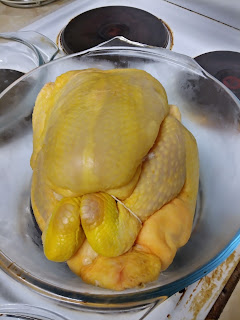
Our local butchers shop is often trying out new products and this weekend I noticed that they had got in some free range chickens via a merchant called Soanes Poultry. These were, looking at the colour of the skin, obviously corn fed and the farmer is not far from Doncaster Airport. These were on a trial price so they will be a little bit more expensive in the future but it is worth paying a bit more for free range if they are available. 


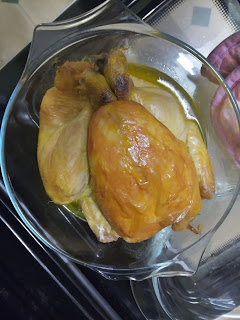
I don't know whether they have bred for ease of carving (or dismantling as I think of it!) but when cooked it was just dropping off the bones and very straightforward to portion up!

It was very tasty, some say that one can detect a difference between corn fed and other types of feeding but maybe I cooked it too long! But a very nice roast all the same and doubly satisfying knowing that it had been outdoors and free range.


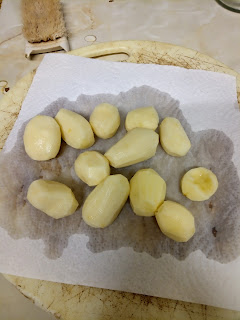
The last of the home grown potatoes from last season went into the dish for roast potatoes. Sacks of potatoes, grown up on the Yorkshire Wolds, are available from our local butchers too. If we had needed any at the time of a recent trip to Harrogate there are a couple of farms on the way there that also do them. 


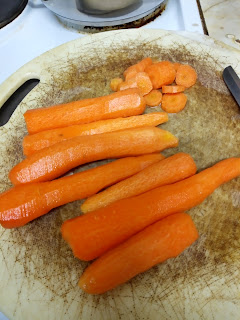
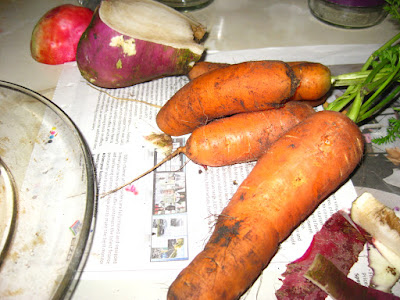
The carrots came from the allotment, grown in our tyre stacks and with the mild winter we have had, these are still growing well. I always have a slice or two raw before they get cooked, they are very sweet and tasty. 


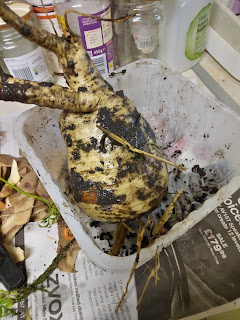
I am not sure how many parsnips are still left under the ground in that section of the allotment but the middles are starting to go slightly woody now. Still plenty of usable parsnip on one this size though!

I have saved a big one in the ground to go to seed for next year though, we nearly always save seed from them. 

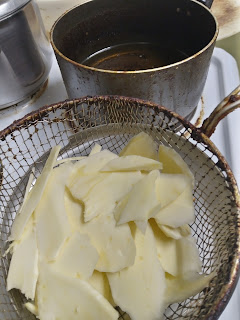
The parsnip was sliced up and deep fried into chips, this only takes a few minutes in a pre-heated chip pan, though of course with such cooking it is imperative that care is taken and the fat does not get too hot before cooking and it is not left alone at all. 


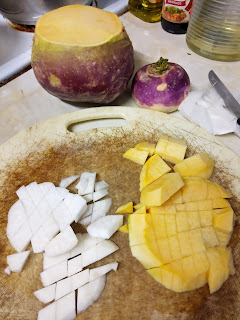
The swede and the turnip were from Peckfield Farm Shop and The Greengrocer in Garforth respectively, although am not sure where in the UK they were grown. Though by using local shops one is putting money into the local community and indeed through the food chain direct to farmers without involving the big supermarkets. 

So, a thoroughly tasty Sunday lunch supporting local producers and retailers!


Tuesday, 9 November 2021

Local dinner!

First of all, for all those reading in the North of England, no I haven't gone posh and decided to call my evening meal 'dinner'! But a headline of 'local tea' would be confusing in other ways, so 'dinner' it is, even though it wasn't at lunchtime!

When I got home from work, light was fading fast so it was a quick trip up to the allotment to pick some carrots and a turnip. 


As I have mentioned many times, the carrots are grown in tyre stacks which gets them above the level of any carrot flies that may be around and protects them when the weather gets colder too. 

In the background of this photo is a striped beetroot that I didn't realise was stripy until I got it home from a local greengrocers , the broccoli was also bought for tea today from there too as our home grown ones have long since finished for the year. 


The potatoes are home grown though, not sure which variety as they are getting a bit mixed up in the boxes now as we work through them. Tasty though and also make good chips. 


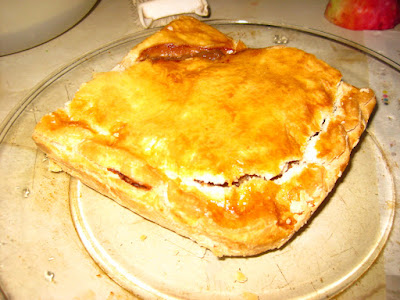
The steak slice is from a local butchers too, they cook a large tray of this several times a week, and sometimes a chicken or spicy Moroccan one, and one can have as much or as little as needed. It is full of delicious steak in a thick layer, from a herd on a farm three miles away.


So, with little effort, and only the gravy granules bought from a supermarket, one can have an evening meal that both is local, fresh, supports local business and is tasty too! 


Sunday, 29 August 2021

Allotment Update - late August 2021


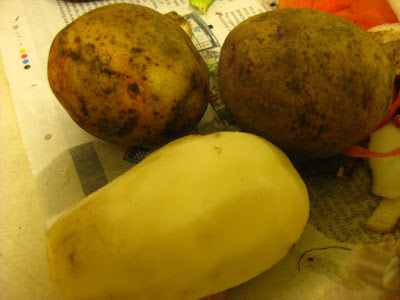
Guess what I have spent a fair bit of time doing in the allotment?! We've been eating home grown potatoes for the past month or so but a couple of weeks ago, the haulms of the many remaining potato plants got the first signs of blight, so I chopped off the leaves, with just stalks remaining above ground to mark where the plants were. I've given the skins of the potatoes a little time to harden off under the ground and then set about lifting them in earnest over the past few days. 

Luckily most of the tubers are in good condition for storing and any that aren't, either with one or two holes from slugs (or by my slicing through them!), get eaten up quickly. I use an old cloth to rub the soil off the tubers, ensure they are dry and then pack them into cardboard boxes with cardboard dividers between each tuber, that way if one does go off, it is not in contact with others in the same box. Looking at the haul so far, we will have our own potatoes until at least Christmas and maybe a little while into the New Year. They make great chips!


This is a snapshot of the harvest about a week ago. Courgettes, too many courgettes! However, the turnip was quite substantial and was used to accompany pies from our local butchers and in a curry. 


One of the perhaps fifty or so onions we have got hanging up in our store, though again we have been eating them since the start of July direct from the plot. Our porch (more a utility room to be honest) is the coldest place in the house and is good for storing potatoes, onions, garlic, apples and pears though the available space was reduced a few years ago when we have converted part of the room into a downstairs toilet (the benefits of this outweigh the reduction in storage in a family of five!)


Won't be long before we have home grown carrots. In between the stacks are some cosmos replacing the earlier wallflowers and behind the cosmos are minarette pear trees and the grapevine which has been productive this year.


The sunflowers are at least eight feet tall! Positioned in between two pyramids of borlotti beans for storing, they are competing with each other for light and so all are growing really tall. The allotment is east-west so they all get sunshine at various points during the day and it doesn't seem to be having any detrimental effect. 


At the top end of the allotment this year are mini sweetcorn and brassicas. The green net has been a very useful purchase over the years and seems to have kept the cabbage white butterflies out. The nasturtiums are useful for many reasons, not only for pollinators but as a distraction plant for blackfly and good ground cover into the winter until they die off with the first frost. 


This Red Admiral butterfly (Vanessa atalanta) was sunbathing midweek in the allotment on one of the carrot stacks and was unperturbed by my pointing a camera at it! We have one also coming to the buddleia bush in the garden along with numerous small tortoiseshell butterflies. 


Monday, 28 June 2021

Allotment update - 28th June 2021

Well, it has just been Midsummer and the weather has decided that it is late September. Whilst the rain is welcome, in that we don't have to do much watering, it does mean that the local slugs and snails have some exciting meals out....


The allotment is divided into five main sections, four rotational beds and one permanent bed, although at the sides of each rotational patch are some permanent planting or pots. The view above is of the top section this year nearest the gate. In the far corner have been some radishes, which are sown every so often so as to keep a succession throughout the season. The turnips that were planted next to them went to seed as this Spring has been rather topsy turvy in terms of weather, first very cold then very dry then very wet into the start of Summer. In the back right there's a bed of mini sweetcorn, started indoors in cardboard tubes and peat pots, at least fifty plants. Each plant will usually produce about three cobs and we freeze them in portions or have them fresh in stir fry. 
The net is covering a mixture of brassicas, some cabbages, calabrese and broccoli, all of which seem to be doing well. The net is to stop sparrows and pigeons from nibbling them and the cabbage white butterflies from laying eggs on them. 


The view above is of the second section of the allotment. This year there's onions, some of which have been picked now, and two stacks with carrots in, both of which have young carrots in now. There's some parsnips out of shot to the right, as well as some leeks and spring onions. In the foreground are the tops of the blueberries which are in pots of ericaceous compost, these are now fully enclosing in the cage now to protect the fruit from birds as it ripens. Though that didn't stop a blackbird trying to poke its beak through last year! In the middle are some cosmos and wallflowers. I have left a few forget-me-nots, ragwort and poppies to grow in gaps, the poppies do seem to attrack blackfly away from other plants and many other insects seem to benefit from their presence. 


One of the carrot tyre stacks, with comfrey to one side and pear trees and the grape vine in the background. The comfrey is a favourite of several bee species that come into the allotment. At the moment the bees seem to be feeding on the blackberry flowers, some nettles and dead nettles I have allowed to grow in a patch of the allotment near the hedge, the comfrey and the cotoneaster. 


After the permanent bed which consists of blackcurrants, raspberries, a damson tree and an apple tree, there's what is. this year, the pea and bean bed. We grow borlotti beans (and occasionally yin yang and kidney beans) nowadays though we used to grow runner and french beans for family until they had access to an allotment themselves through an In Bloom group. There's a few courgettes in this bed too, alongside the overwintered broad beans, which are producing well at the moment. It always has puzzled me why broad beans need so much pod for perhaps five or six beans, though it has been suggested to me that they need plenty of insulation given the cold Spring we have had!


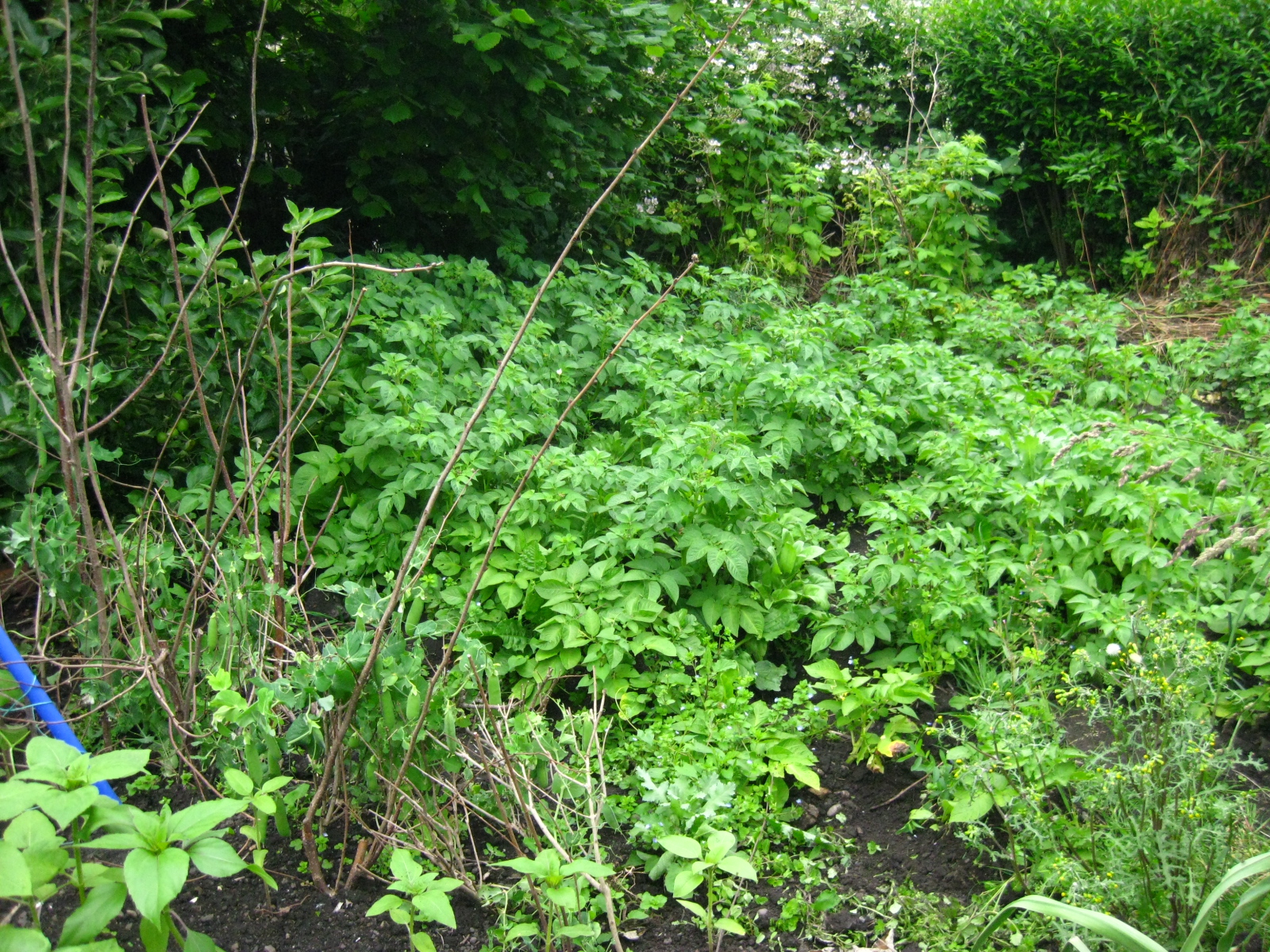
Down the bottom of the allotment this year is the potato patch. Red Duke of York and Kestrel this year. We used to grow a lot of Desiree but in recent years the yields haven't been too great. I did get some Sarpo Mira one year which were really productive but are difficult to get around here without ordering them, and that is an expensive way to get potato seed when there is a nearby nursery we can get loose ones in any quantity from. 


The potatoes had plenty of earthing up against the very late frosts (last one was early May and there were some cold nights even after that) and there's a few flowers on them now. Once we have finished the sack of potatoes bought from the local butchers (with the potatoes coming from the Yorkshire Wolds) then we'll start on ours. At the back of the picture above is the hazelnut tree which grows very enthusiastically, hopefully we'll have some hazelnuts again this year. We didn't plant the tree, it was there when we got the allotment and survived half of it being chopped down in the neighbouring allotment when it was cleared for use by the landowner. There's blackberry bushes at the back too, which the bees are loving for the blossom at the moment. 

So, lots of work to do. Today, having checked for birds, I finished off giving the hedge a trim, having started this last week and combined this work with removing nettles from the blackcurrant and raspberry bushes and some other weeding. We also got some swift boxes put up on the house today but that is for another blog...


Sunday, 6 June 2021

Allotment Update - 6th June 2020

Finally, over the past week or two, the weather has improved and there's been some warm sunshine! The garden and allotment have responded and it now looks like we actually grow things!

Today, these were the first of the broad beans to have with Sunday lunch, the plants being overwintered with protection on the coldest nights in winter and early Spring.


They have grown a bit sideways rather than up but I think that is the wind, rain and a bit of snow over the winter months. 

Also shown on this photograph is what may be the last of this season's asparagus, as we've been picking it now for several weeks it may be time now to let the plants rest and recover for next year. There's three asparagus plants and an action for over the winter will be to build this bed up better to give more protection from late frosts.

Sunday lunch was a piece of lamb shoulder from our local butchers, the lamb having been raised on a farm three miles away. Quite lean actually for a shoulder cut and delicious with mint sauce, gravy and vegetables. 

"Peas release me, let me go.....". Maybe not quite the song of Engelbert Humperdinck but it is now time to uncover the pea plants now they are flowering and hope that the local pigeons and sparrows don't have some kind of party! 

For some reason this year we have had trouble getting peas to germinate so this row is all that we have, which is a shame. 


This is the potato patch down the bottom of the allotment this year. Struggled to find space to get all of them in to be honest and had to do a lot of earthing up against frost until May, Now, they seem quite healthy and are growing well. Just need watering now until picking the first ones come the end of July. 


This photo is taking looking over the blueberries, whch will need netting over soon, and the carrot tyre stacks towards the blackcurrants and pear trees. Plenty of pears on the Comice (nearest the camera) but fewer on the Conference (behind) due to the late frosts. Not many damsons for the same reason but we still have some in the freezer from last year! Although you can't see them very well on this photo there are some Cosmos between the tyre stacks. 


Sunday, 2 May 2021

Allotment Update

It is a very slow start to Spring at the moment. Unduly cold, lots of overnight frosts and, it is said, the frostiest April in sixty years here in England. On many evenings we have had to go and cover seedlings and the fruit trees to protect them. 

The little lean-to greenhouse in the front garden has been getting full!


I think the damson tree hasn't appreciated the cold nights and there's nowhere near as much blossom that has "set" than this time last year. Perhaps just as well - there's still some damsons in the freezer! The Conference pear tree might not have as many on either this year, 

However, the apple trees are in full blossom as well as the Comice pear tree. 


This is the Falstaff, which is along the back fence, and gets the sun for most of the day. Last year I picked well over a hundred apples from this minarette tree and it looks to be a good year this year too as long as we don't get any more cold weather. 


This is the Gala apple tree, a reasonable crop last year but with it being very late ripening it has to be netted against hungry blackbirds, some apples aren't ripe until early December! 


This is the Chivers Delight apple tree which is getting overshadowed a little bit by the hazelnut tree at the back of the allotment. However, last year it had the biggest apples it has ever had, a yellow apple much more sweet than a Golden Delicious. 

The rhubarb in the foreground was a division from the main plant a couple of years ago and looks like it is now well established. I have frozen some already from the main plant and will, once I have sufficient, make a rhubarb compote for use with porridge or on bread. 

The potatoes have also needed considerable earthing up this April with the regular late frosts. However, with protection of the broad beans, peas, turnips, strawberries, blueberries and radishes, it looks like we have been able to ensure everything survived. 

The asparagus has been coming up and we have had, I think, three pickings from it now. 


There's been plenty of purple sprouting broccoli, we have around a dozen plants and although I don't like the taste of it one bit (!) the others in the family eat it regularly. There again, there's only two of us that eat leeks, including me, and there's only myself that eats gherkins, but there's always something for everyone in the thirty-five or so varieties of fruit and vegetables that we grow in the allotment, yard and house!