Another cycle ride today, a little bit further than yesterday and to be honest a little bit more focused on the exercise rather than the wildlife spotting!
However, there were a few interesting sightings as we cycled over as far as Hessay and Moor Monkton. First of all when cycling through Catterton - which often seems to be a good place to see wildlife - two curlew were chasing off a crow in a field and making quite an alarm call while they did this! As usual, the hedgerows had many Chaffinches, Blue Tits, Dunnocks, Robins and other small birds including a couple of Yellowhammers. Chaffinches always seem the most raucous! At various points during the ride, Blackcaps could be heard in the trees, they usually choose a high branch and take some finding even at the moment where there are few leaves on the trees.
When we were cycling through Hessay - a small village near York - there were two Swallows on the telegraph wires - first ones I have seen this year! Now, one Swallow does not a summer make (or even two), a remark which has been attributed to Aristotle back in the 4th Century BC! (https://en.wiktionary.org/wiki/one_swallow_does_not_a_summer_make)
As we were waiting for the level crossing gates to open at the Moor Monkton crossing on the York-Harrogate railway line (and reflecting on - given how the train services have been reduced - how unlucky we were to have to wait for one!) we watched a Lapwing diving and soaring over a field then fly over to chase some crows.
Coming back past Rufforth airfield two Mallard ducks were sitting in the grass verge completely unconcerned - or maybe too lazy - to move as we rode past and near what is known as Normans Farm two Shelduck flew over which given that this is quite some way from a lake or major river was rather unexpected.
So, even during what was a leisurely ride through the countryside, there were twenty-six species of bird, and a hare running across a field too! Now that a lot of grass verges are being left uncut in Spring there are - it seems to me anyway - an increasing number of wildflowers present which can only be good news for pollinators and biodiversity generally The wild garlic in woodlands is now coming into flower and releasing the distinctive smell in among carpets of bluebells.
Saturday, 18 April 2020

Friday, 17 April 2020
Lockdown Day 25 - Wheatears
I decided that today would be another cycle ride while the weather is fine, and having heard about a group of Wheatears (Oenanthe oenanthe) near Colton not far from York, I decided that it was a good point to aim for and not too far from home. Although the sky was bright, and there were occasional glimpses of the sun, it was a lot colder than I expected and the wind was from the east.

Wheatears (or sometimes known as Northern Wheatears) migrate from sub-Saharan Africa to our shores with many carrying on to Iceland and Greenland (O. leucorhoa, the "Greenland Wheatear), in fact some - on the way back - follow a path down through Canada, then flying over water to the Azores, a distance of over 2000 miles, before continuing down to Africa. https://en.wikipedia.org/wiki/Northern_wheatear#Migration
 I had seen online that a group of up to seven birds were in a field near the railway bridges in Colton and after a few minutes I was able to pick them out against the bare earth of the field. They are really quite well camouflaged!
Wheatears are possibly named after a corruption of the term "white-arse" referring to the bird's white rump!
 Three individuals (all male) were in the field and they moved around quite a bit, although will stand quite erect looking around for danger. They eat insects from the ground or bushes or catching them in the air.
Another bird I saw on my cycle ride which I really don't see often is a Marsh Tit (Parus palastris) . These birds are really quite hard to tell apart visually from Willow Tits (P. p dresseri) but are distinguished by their call which is a repeated "pitchoo pitchoo" which is what the individual I saw in Bilborough was doing repeatedly as it hopped around a tree looking for food and claiming its territory. I also heard several Blackcap warblers (and saw one) and the chiffchaffs were being their usual repetitive selves as they claim their patches for summer.
https://en.wikipedia.org/wiki/Marsh_tit

Wheatears (or sometimes known as Northern Wheatears) migrate from sub-Saharan Africa to our shores with many carrying on to Iceland and Greenland (O. leucorhoa, the "Greenland Wheatear), in fact some - on the way back - follow a path down through Canada, then flying over water to the Azores, a distance of over 2000 miles, before continuing down to Africa. https://en.wikipedia.org/wiki/Northern_wheatear#Migration

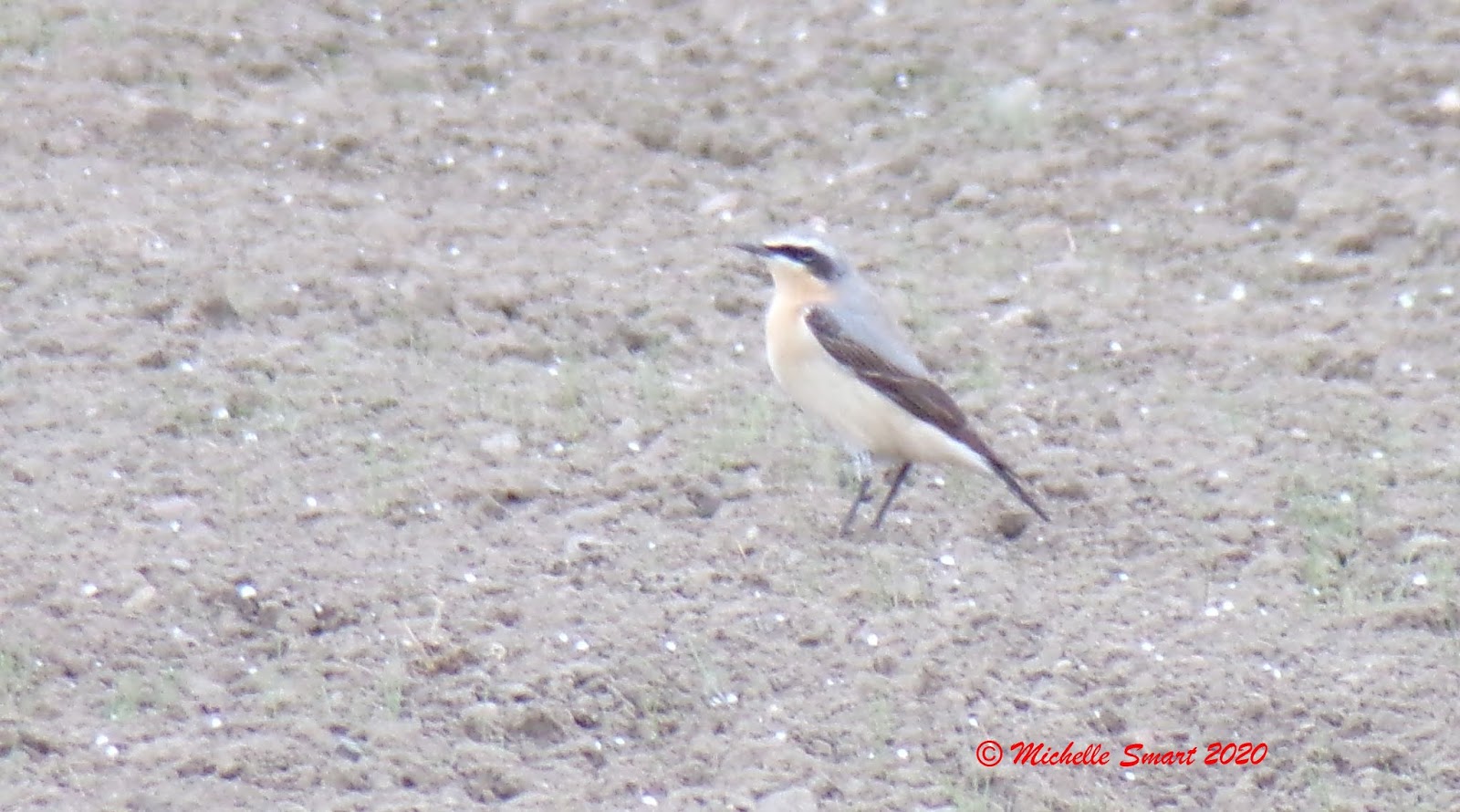

Wheatears are possibly named after a corruption of the term "white-arse" referring to the bird's white rump!


Another bird I saw on my cycle ride which I really don't see often is a Marsh Tit (Parus palastris) . These birds are really quite hard to tell apart visually from Willow Tits (P. p dresseri) but are distinguished by their call which is a repeated "pitchoo pitchoo" which is what the individual I saw in Bilborough was doing repeatedly as it hopped around a tree looking for food and claiming its territory. I also heard several Blackcap warblers (and saw one) and the chiffchaffs were being their usual repetitive selves as they claim their patches for summer.
https://en.wikipedia.org/wiki/Marsh_tit
Thursday, 16 April 2020
Lockdown Day 24 - The Cabbages are Defended!
Once again, it has been a lovely sunny and warm day here. Very dry though, not much rain at all in the past couple of weeks and walking up through a field the other day when we went to Catterton Rash (see https://www.cashandcarrots.com/2020/04/lockdown-day-22-walking-bluebell-woods.html) the soil was dusty and the lack of rain must be a problem for farmers trying to sow crops, in fact lower down this field the farmer had two sacks of barley ready to plant out and was rolling the field ready for this.
 Over the past few weeks, the windowledge in a bedroom and subsequently the lean-to greenhouse have been filled with cabbage, broccoli, calabrese and pea seedlings and with the warmer weather, these have been going into the allotment.
Although some of the more open allotment plots have real trouble with pigeons, ours - with hedges around it - doesn't as I think the pigeons prefer having a good all round view for safety and the hedge blocks this.
However, the local house sparrow population are another matter! Now, I like house sparrows and indeed over the past twenty years or so they have declined a lot here in the UK. They are still the most numerous bird in the Big Garden Birdwatch list, but they have declined a lot since the 1970s both in urban and rural areas due to habitat loss. https://www.bto.org/our-science/projects/gbw/about/background/projects/sparrows .Some suggest that pollution in towns is also a factor.
 Unless we protect the peas, cabbages and indeed the lettuces in the back yard, the sparrows will come along, tell their friends and have a party, and the poor plants end up with beak shaped chunks cut out of them!
Once the plants are sufficiently big, we'll take the netting off them, and indeed it is not a good idea to allow the peas to grow through or attach themselves to the netting as it is a really difficult and delicate job to untangle!
There's more peas and brassicas in the house being germinated, along with courgettes and pumpkins and a couple of gherkins, as well as some new pepper plants that are doing well on the bathroom windowsill.

Although some of the more open allotment plots have real trouble with pigeons, ours - with hedges around it - doesn't as I think the pigeons prefer having a good all round view for safety and the hedge blocks this.
However, the local house sparrow population are another matter! Now, I like house sparrows and indeed over the past twenty years or so they have declined a lot here in the UK. They are still the most numerous bird in the Big Garden Birdwatch list, but they have declined a lot since the 1970s both in urban and rural areas due to habitat loss. https://www.bto.org/our-science/projects/gbw/about/background/projects/sparrows .Some suggest that pollution in towns is also a factor.

Once the plants are sufficiently big, we'll take the netting off them, and indeed it is not a good idea to allow the peas to grow through or attach themselves to the netting as it is a really difficult and delicate job to untangle!
There's more peas and brassicas in the house being germinated, along with courgettes and pumpkins and a couple of gherkins, as well as some new pepper plants that are doing well on the bathroom windowsill.
Wednesday, 15 April 2020
Lockdown Day 23 - Remembering the Leeds Rose
 Last October, we had a holiday in Germany. Once the places we visited was Dortmund, which is the twin city of my home town of Leeds, Yorkshire, and one of the ways in which this is commemorated is in the Dortmund Westfalenpark with a Rose Garden.
Now, at the end of October, the roses are just about coming to the end, but we found that the rose garden was set out with a low hedge in the shape of a Yorkshire rose, with a commemorative sign explaining about the twinning of the two cities.
Luckily, we found a couple of the roses still flowering.

You have to pay to go in the Westfalenpark, which seems quite odd for a city park - at least in terms of what we experience in England - and you can't go out and come back in even if you have a ticket, you would have to pay twice! This rather put a hole in our plans as we were planning on walking through the park to an English speaking church service then returning to the park in the afternoon. So, we spent all day in the park, which wasn't too much of a hardship, there are nice grounds and lake and indeed a nice cafe in the middle of it, as well as a miniature railway for children. In the summer there would have been a cable car too and other attractions but they were closed for the winter.
Tuesday, 14 April 2020
Lockdown Day 22 - Walking the bluebell woods - part 1

So, today our government authorised (or should I perhaps call it State Sponsored?) walk was up into a local woodland known as Catterton Rash.
Much of the floor of the woodland is covered in bluebells and at this time of year is absolutely lovely to see!

This is some kind of bracket fungus growing on a silver birch tree (possibly Fomes fomentarius??)

Also, there must have been some brush clearance or work since last time we went as I have never come across this ditch before or the boggy marsh beyond. Though at the moment many trees are just coming into bud and so the woods aren't as dense as they will be in the summer.
At the moment, it is vital that we all take the chance to step away from the scrolling news, the social media alerts and chimes, and take the time to relish the quietness of the forest, of the open fields, even parks and woodlands in towns and cities where traffic noise is but a shadow of the normal drone. Obviously keeping to the social distancing and exercise rules set by the Government! I am very glad that I don't live in a city nowadays, although have done whilst at university, and have such beautiful spaces within a few minutes walk or cycle of where I live. You don't need to go racing across the country to stand in a line with hundreds of others to see a rare bird, you don't need to spend thousands on the latest camera or bike to enjoy the nature around us. Indeed for many people just seeing hares race across a field, lapwings sky dancing, hearing a skylark song or the sudden, yet fleeting, glimpse of a deer between gaps in a woodland is a special experience and one that they don't usually get in their concrete filled urban sprawl. Even within cities there are the edge-lands and the corners of parks where birds, insects and mammals get on with their lives unnoticed by the headphone wearing joggers, the sunbathers, and the phone attached teenagers. We were once eating lunch under a tree in Museum Gardens, York and had a wood mouse potter around our feet! An abandoned building plot full of buddleia can be a magnet for butterflies, an unusual moth can appear on your doorstep, pipistrelle bats flit around the rooftops in the twilight of late summer evenings. The webs of dozens of spiders glistening on a garden hedge on a cold morning or rabbits eating their way through the manicured grass of a business park when everyone has gone home.
Nature is all around us, and we need to keep it that way.
Monday, 13 April 2020
Lockdown Day 21 - Close up Cranefly
One of many things I enjoy doing is taking close up photos of insects. This does require some patience and the insects are not always that cooperative!
 On one cycle ride around this time last year I had stopped briefly for some reason and noticed this Cranefly in the grass verge.
This is - to my knowledge - the cranefly Tipula vernalis . The larvae are called Leatherjackets and eat roots and the adults feed on nectar.
The thing that really struck me about this one was the iridescence on the wings and indeed the detail as you get with any close up view of an insect.
One thing I do need to get around to is putting my sightings of various plants, animals, birds and insects on the National Biodiversity Network (NBN) Atlas. Looking for this particular species gives a previous record back in 2002 for one not far from where I saw this one.
https://records.nbnatlas.org/occurrences/219ca574-a55b-4db1-aee4-8d4ccf07f606
 On one cycle ride around this time last year I had stopped briefly for some reason and noticed this Cranefly in the grass verge.
This is - to my knowledge - the cranefly Tipula vernalis . The larvae are called Leatherjackets and eat roots and the adults feed on nectar.
The thing that really struck me about this one was the iridescence on the wings and indeed the detail as you get with any close up view of an insect.
One thing I do need to get around to is putting my sightings of various plants, animals, birds and insects on the National Biodiversity Network (NBN) Atlas. Looking for this particular species gives a previous record back in 2002 for one not far from where I saw this one.
https://records.nbnatlas.org/occurrences/219ca574-a55b-4db1-aee4-8d4ccf07f606
Sunday, 12 April 2020
Lockdown Day 20 - Spring Blossom in the Allotment
It is perhaps fitting that on Easter Sunday I put a few photos on the blog of the blossom in the allotment on the apple, pear and damson trees. After being dormant for the winter months, first the buds appear and then when the weather is warm enough, the trees burst into blossom and the bees get busy!
 This is the Chivers Delight minarette apple tree. This produces quite small but tasty yellow skinned apples although does tend to get overshadowed a bit by the hazelnut tree to the rear of it.
 This is the damson tree in bloom. Last year the quantity of damsons from this tree was overwhelming, perhaps over 300 of them, in fact we still have two bags in the freezer! We don't expect quite as many this year, most other years it has produced about 60-80 damsons.

This is the Falstaff apple tree, trained along the back fence of the allotment. These are quite long storing apples, although this is generally the first tree to produce ripe fruit, followed by the Chivers Delight then the Gala (not pictured), the latter of which can still have unripe apples on well into November, and a few still pickable in December.

This is the Comice pear tree. All our apple, pear and the damson tree are minarette sized trees as there's a restriction of height in the allotment rules. If we ever left the allotment we'd have to uproot them and take them elsewhere!
The Comice pears are very much a dessert apple and one to be eaten pretty quickly after picking, whereas the Conference pear tree next to it has longer storing pears.


This is the Falstaff apple tree, trained along the back fence of the allotment. These are quite long storing apples, although this is generally the first tree to produce ripe fruit, followed by the Chivers Delight then the Gala (not pictured), the latter of which can still have unripe apples on well into November, and a few still pickable in December.

This is the Comice pear tree. All our apple, pear and the damson tree are minarette sized trees as there's a restriction of height in the allotment rules. If we ever left the allotment we'd have to uproot them and take them elsewhere!
The Comice pears are very much a dessert apple and one to be eaten pretty quickly after picking, whereas the Conference pear tree next to it has longer storing pears.
Subscribe to:
Posts (Atom)