Saturday, 25 April 2020

Lockdown Day 33 - Holgate Windmill

As many people will already be aware, trying to get flour of any description during the lockdown has been difficult, if not impossible, from mainstream shops. It isn't, apparently, an issue of the amount being produced not keeping up with demand as with catering and restaurants closed, there is plenty of flour in the supply chain. However, it is an issue of bags - for the catering and restaurant trade, flour is generally bought in large quantities, and the spike in demand has been for the 1 and 2kg bags you get from supermarkets and the like.

The BBC article here explains the issue better.

I discovered that Holgate Windmill in York, which has been producing a small amount of flour for open days and as fundraising, has opened a shop on a Saturday morning to cater for demand and they are running the windmill up to four days a week now, weather permitting, to produce flour.

The shop is at a hatch in the base of the windmill, you can just see it in the photo below the first window at the end of the road.

The road goes round the windmill on either side. To be truthful, if you don't know about the windmill it is not that obvious due to the built up nature of the area!


We cycled over there this morning and when we arrived the queue was about ten people ahead of us, but when we left the queue was all the way down the lane! They limit flour to one 1.5kg per customer in order that more people can benefit, but also have local honey for sale too. You can choose from wholemeal or spelt flour, although in normal times they do a range of other flours.

The notice (you may have to enlarge on your device - and there's more info on the website) explains where the grain for the flour comes from and even some handy recipes!


 Here is the flour we got this morning.

The windmill is celebrating its 250 year anniversary this year, although unfortunately they won't be able to celebrate properly due to the restrictions.

I am hoping during one of my exercise trips in the lockdown to be able to cycle past there on a day when the windmill is going, but if it is a windy day it is a struggle to cycle!

Flour from a working traditional windmill!

https://www.holgatewindmill.org/

Friday, 24 April 2020

Lockdown Day 32 - Garden and Allotment

So, today was a mixture of sorting things out at home on the computer, and some outdoor work both in the garden and in the allotment.

In the garden we are going to try growing beans up the swing frame, this is something we do in the allotment anyway but now that the children are grown up we can use the one in the garden too. I have also been filling a hanging basket with aquilegia seedlings and sorting out pots ready for more flowers and vegetables in pots. I was thinking about growing a pumpkin up the swing frame but wonder whether the pumpkins will be too heavy and it will be better growing along the ground.

In the allotment, the only job for today was more watering as the ground is so dry, I can't remember the last time it rained here.

These are some of the blueberries, and they are in blossom. Even though they are at the allotment they are in pots of ericaceous compost as they need an acid soil and we only water them with rainwater from the water butt or they get rained on - maybe one day soon!


This is the grape vine we have. It does produce several bunches of grapes and I thin them out quite severely in order to ripen them. The problem is, despite netting, something eats quite a lot of them as soon as they are ripe.

I need to have a read up and see when some pruning needs to take place but it won't be until fruit appears at the earliest.
 All the potatoes are now coming up, and I don't think frost is likely - however that being said we have had a damaging frost in early May before now. I have planted Cara and Red Duke of York this year. I did often plant Desiree for many years but the past couple of years they have not worked out well for me, so none this year. I have been a little disappointed not to get Sarpo Mira again this year, two years ago I bought some and they were the best white potato crop I have had. I find that red potatoes do better here as they don't seem to get nibbled as much or have the slug/wireworm damage that later white ones get.


We are very lucky. We have the allotment, some yard space, a small garden, and live on the edge of some beautiful countryside, even though we live in a terraced house on the edge of a small town. I really am not sure how I would have coped with this lockdown living in a flat or inner city where the options for safe exercise and opportunity to grow food is limited and there would be far more people about. I can think of at least eight different walking routes within two or three miles of the town and there are numerous country lanes for cycling on without coming across many people too. The allotment is two minutes walk from the house and has low rental cost compared to many allotments elsewhere (though there is no allotment association, but there are rules set by the landowner). Whilst it would be a lot harder, I do think I could still find enough to do if I wasn't able to go out much or at all, I read up a lot on science and environmental topics, I knit sometimes, play clarinet and piano among other things. Inside we grow peppers, lettuce and sometimes tomatoes, and in the back yard we have strawberries, a minarette fig tree (only 3 or 4 figs each year so far but still....!) and a small lean-to greenhouse for growing tomatoes or cucumbers/gherkins and peppers. We also grow sweet peas and pansies in the yard and the garden - despite being quite small - has a large hawthorn tree at the end which has beautiful pink blossom in May, there's a buddleia, hollybush and fuchsia and a few flowers. We are trying to grow more flowers that are pollinator-friendly although we do get tawny mining bees in the bare patches in the lawn (which I have wildflower seeded now)  and plenty of hoverflies and bumblebees coming in. Our allotment is run organically as far as we are able - for the past four or five years now we have not had to resort to any chemical treatments - the last time was Diphane for controlling some black spot fungus that got out of control on the pear trees as nothing else seemed to work and I needed to save the trees. They recovered and have been fine since.

We work with nature, not against it, and are rewarded with lovely fruit and vegetables and the pleasure of seeing birds and insects, beetles and spiders all being part of the ecosystem in the garden and allotment.

Thursday, 23 April 2020

Lockdown Day 31 - Wild Flowers and Warblers

On what seems to be one of the endless sunny days this April, I took a cycle ride out towards Bolton Percy this morning with the aim of taking some pictures and trying to identify some of the wild flowers in the verges.

About half way along the lane you come to a long section of bluebells by the roadside and in amongst them is Greater Stichwort (Stellaria holostea). These flowers look like they have ten petals but they are in fact five but the divides in the petals do go quite far down.

https://en.wikipedia.org/wiki/Stellaria_holostea


Here is a closer look at the plant. In traditional folk medicine it was said to alleviate a stitch in one's side, hence the name! They flower from April to June.


On the opposite side of the road to the Bluebells is a long patch of Ramsons or Wild Garlic. (Allium ursinium). The leaves are edible, as are the flowers. I haven't yet tried the leaves but have sprinkled a few flowers into dishes. There are quite a number of places, usually around tracts of ancient woodland, near where I live that have large areas of bluebells and wild garlic and wood anemones.
https://en.wikipedia.org/wiki/Allium_ursinum


On the way home I spotted these pretty flowers at a road junction, against a wall with some white dead nettles.

These are Green Alkanet or known as Evergreen Bugloss (Pentaglottis sempervirens) These are an introduced species to the British Isles though have long since become widespread.

https://en.wikipedia.org/wiki/Pentaglottis_sempervirens

Also on my ride were quite a few warblers singing. The Chiffchaffs and Blackcaps have been around for a while now, but in the past few days the Willow Warblers have arrived and several have set up territories along the road in copses and trees. At the moment it is fairly easy to spot warblers as there is not too much growth on trees and bushes but even so they have a tendency to be singing from the opposite site to the road and it is only when they move you can see them. That being said, one Willow Warbler was quite showy this morning and I watched it for a couple of minutes hopping around and singing from a small tree by the road. I also noticed that one Chiffchaff was giving a "hoo-ee" call for a while - normally you just get the monotonous chiff-chaff-chiff-chaff. I also saw two Wheatears again in the same field as the other day and there were plenty of Chaffinches, Goldfinches and Great Tits all singing and calling as well as two Skylarks singing high above fields.


Wednesday, 22 April 2020

Lockdown Day 30 - Remembering a Water Rail

Today, whilst being a lovely day, has been the shopping day and it takes a fair chunk of the day due to queuing outside each shop visited. So, this is another recollection blog.

In February 2019 I had a little time to spare whilst up near Boroughbridge, North Yorkshire and near there is Staveley, a Yorkshire Wildlife Trust reserve. At this point I must mention that the Government advice is to exercise locally and so whilst it is a lovely reserve to visit and very soon such as Common Terns will be nesting there, if it is not local to you then please save it up for when all this crisis is over!

About 15 minutes walk from the car park is a hide, with bird feeders to the side and a reedbed and the lake out front. Being February, it was quite cold but from experience both here and at RSPB Fairburn Ings, this is the best time to see a Water Rail as they come out of the reeds more often looking for food. They are really quite secretive birds otherwise. Water Rails are omnivores and will eat most small creatures up to even small mammals and amphibians as carrion as well as vegetable matter, seeds and nuts.
https://en.wikipedia.org/wiki/Water_rail


This one came out of the reeds and proceeded to potter around the base of the bird feeder (as I have also seen at Fairburn Ings at the side of the visitors' centre!) eating seeds and grains that had dropped down from the feeders. From where I was standing just next to the hide it was probably only about five or six feet away from me and really wasn't noticing my presence.

It then went back into the reeds completely hidden from view.


Tuesday, 21 April 2020

Lockdown Day 29 - quick update and link to an online conference

Today has been yet another sunny day, we are so lucky at the moment with the weather. I must admit a lockdown with wall to wall rain would have been rather harder to bear!

Today was a trip to the allotment to build a bean frame out of hazel branches coppiced from the hazelnut tree at the back of the allotment, and general weeding and watering. The strawberries are now flowering, these are plants put in last year when we renewed the bed.

I have also been following the online content and speakers from the We Don't Have Time Earth Day Week conference taking place at the moment, today when I tuned it were speakers from various companies providing products and services in the so-called circular economy.

Link to the main website and the app here

I have also been writing a letter to the Cabinet Office in Whitehall in response to a series of questions put out on Twitter regarding the recovery from COVID-19 and I will be making a blog post about this sometime over the next week.


Monday, 20 April 2020

Lockdown Day 28 - Macro photography in the allotment

 I have been taking photos since childhood. My Dad is, and my Granddad was, a keen photographer and I remember watching my Granddad editing Cine films on his own equipment and my Dad told me that when he was at home, my Grandad had a dark room in the attic where he developed his own photographs.

Whilst I can't afford a DSLR and long range lenses, I have recently got a Kodak Bridge Camera, but before that I have been using a small Canon digital camera which has quite a decent macro setting on it. (A long time ago I had a Praktica SLR film camera with a 70-210 lens and 28-70 lens with macro on, but getting film is difficult now and costly)
Whilst the newer Kodak camera is much better resolution and features, I still sometimes take the mini Canon one to the allotment for photographing the crops, flowers and the insects that come into the allotment.
 We've had a lavender bush for some time in the allotment and to be honest it is getting past its best now and needs replacing. However, it is a magnet for bees and butterflies and indeed moths on an evening. Getting a good shot of bees is quite difficult unless they are sleepy and they never stay still for long.
 Hoverflies are common in the allotment and we try to make sure there are flowers for the pollinating insects in general there. Obviously, the fruit trees have blossom in Spring, but we also leave a few dandelions and poppies and let a couple of leeks and parsnips go to seed. We also grow stocks, nasturtiums, marigolds and cornflowers and the courgettes and pumpkins, beans and peas also set flowers in summer.

Hoverflies, wasps and ladybirds are very good for getting rid of aphids.

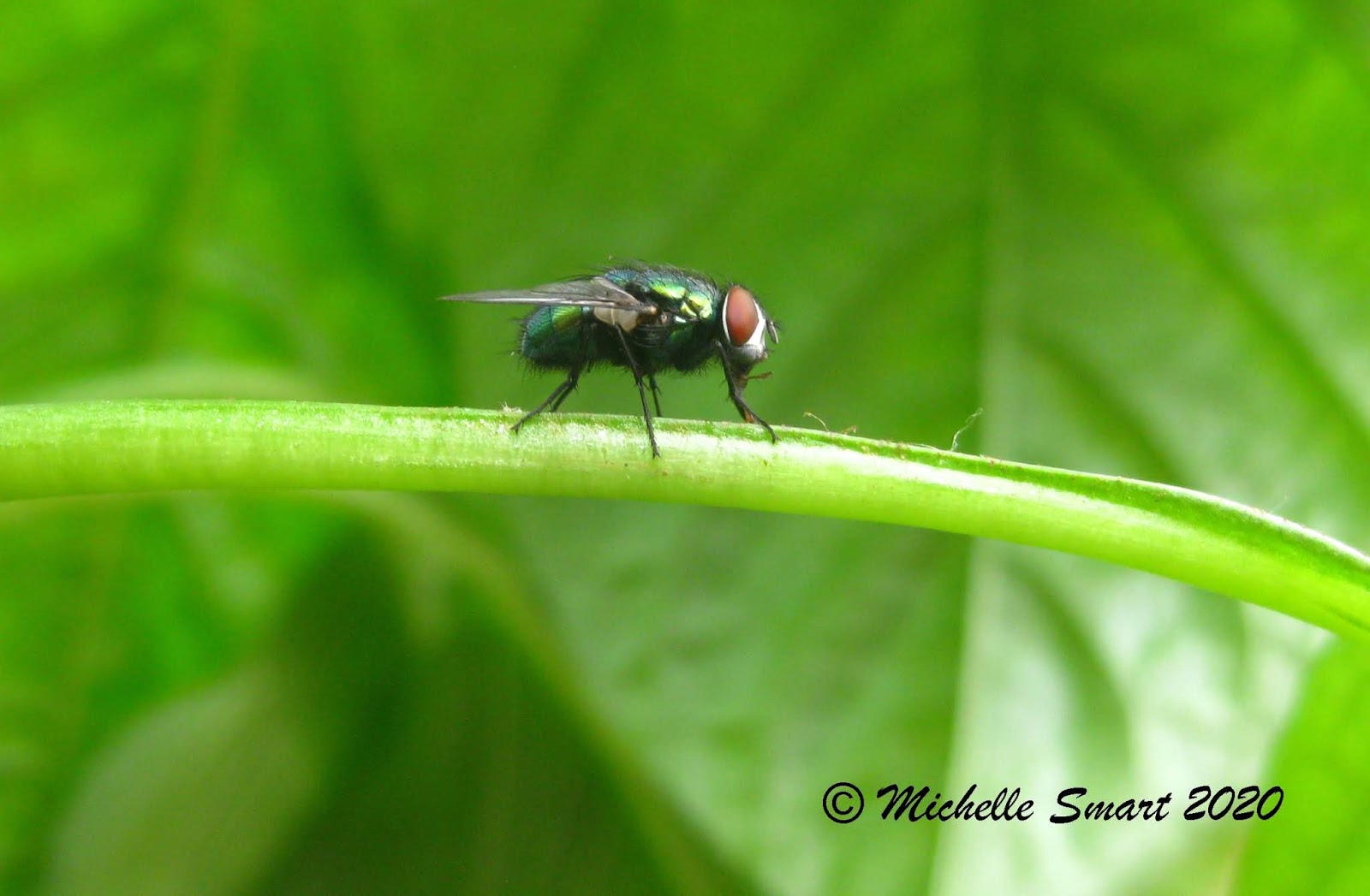
Even just an ordinary fly is fascinating close up with the multifaceted eyes and luminescence on the wings. Greenbottles are also quite dazzling close up.

We grow organically and believe that working with nature, not against nature is the way to healthy crops, and everything has a balance, with predators there for the prey. Our soil is teeming with worms and centipedes though we also have millipedes and ants which are less attractive, but they all fit into the same ecosystem. There's leatherjackets and other bugs for the Robins and Blackbirds and there's spiders and a whole range of other species too. It has unfortunately been some years since we have had grasshoppers. Blue Tits forage for tiny insects and Dunnocks unobtrusively potter around the bushes. We often get Wrens and the Mistle and Song Thrushes have bred in the allotments over the past few years and last year the blackbirds raised three broods in the hedge that surrounds the allotment.
The first photo, of cabbage white caterpillars is not something to be welcomed though as they can decimate any brassicas left uncovered - I do squish them if I see them, but would never use chemical controls as these would have unwelcome side effects and our allotment flourishes without them.

Sunday, 19 April 2020

Lockdown Day 27 - Allotment work

Today it was back to the allotment. Lovely sunny Spring day again, and the forecast is for dry sunny weather for the rest of the week. The ground is getting very parched though and one of the tasks for task was watering all the vegetables and the fruit trees in pots, as well as a bit for the larger fruit trees.

The Falstaff apple tree is in full blossom, these apples are the first to be ready in September and keep well too. I have had over one hundred apples from this little tree in the past and this year, all being well, looks to be another good one.


Along the same side of the allotment as the Falstaff apple tree are the strawberries. We replaced the whole bed with fresh plants last year and this year they are obviously maturing and flowering.

We also have some strawberries in planters on the wall of our back yard.
Although this doesn't look like much, these are the final ones of last season's leeks. Our aim, though we don't always succeed with continuity of fresh veg, is to have something from the allotment every time we need it, and having had the first batch of asparagus the other day it looks like we may be in luck this time.

We can though have jam with allotment fruit every day of the year and there's pumpkin and courgette chutney too as and when we need it. This year I need to increase the number of Kilner jars with preserved fruit such as blackberries and blackcurrants in for use on porridge and with muesli. We do still have though some blackberries in brandy though it might not be a good idea to have these on porridge for breakfast!